Saturday, September 19, 2015

The Secret History of Oil and Money - Part 5


Paper Money was published in 1981, so the readers don't know what happened next. But we do, of course, because we are living through it. I'll try and sketch in the details briefly with the help of Wikipedia and a few other sources.

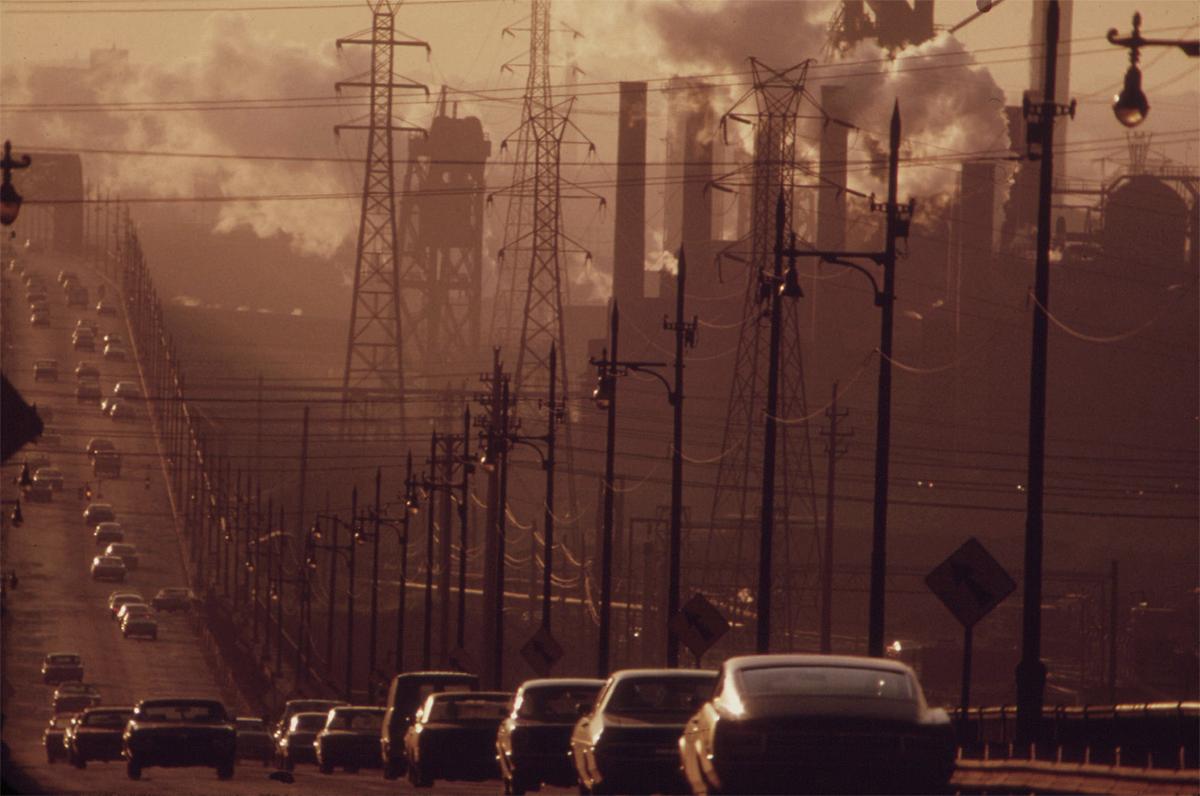
The late 1970s were a time of discontent. Jimmy Carter gave his "Crisis of Confidence" speech (sometimes called the "Malaise" Speech), Britain experienced the "Winter of Discontent," and the Soviet Union entered the Era of Stagnation. It all had to do with high energy prices. Oil, having driven the boom, and now the major energy source of the industrialized world, had risen tenfold in a decade bringing down the industrialized economies. The industrial nations were also heavily polluted in the late 1970's. Confidence in nuclear power, once seen as the energy source of the space age, evaporated at Three Mile Island in 1979, and later at Chernobyl. It seemed like the post-war Keynesian consensus had let everyone down.


1974-1975 was a terrible recession. Unions, hit by the cost increases, went on strike. Garbage piled up in the streets of New York City. In 1975, New York went into debt restructuring. There was even a spike in crime and lawlessness that defied explanation. Some have convincingly argued that the introduction of lead into gasoline to stop engine knock was the cause of the crime outbreak due to lead poisoning:
Fourteen years ago, Prof Jessica Wolpaw-Reyes, an economist at Amherst College Massachusetts, was pregnant and doing what many expectant mothers do - learning about the risks to her unborn child's health. She started to read up on lead in the environment and, like Nevin before her, began pondering its link to crime.

"Everyone was trying to understand why crime was going down," she recalls. "So I wanted to test if there was a causal link between lead and violent crime and the way I did that was to look at the removal of leaded petrol from US states in the 1970s, to see if that could be linked to patterns of crime reduction in the 1990s."

Wolpaw-Reyes gathered lead data from each state, including figures for gasoline sales. She plotted the crime rates in each area and then used common statistical techniques to exclude other factors that could cause crime. Her results backed the lead-crime hypothesis.

"There is a substantial causal relationship," she says. "I can see it in the state-to-state variations. States that experienced particularly early or particularly sharp declines in lead experienced particularly early or particularly sharp declines in violent crime 20 years later."
Did removing lead from petrol spark a decline in crime? (BBC)

The unions, striking to gain higher wages to cope with higher gasoline prices, came to be seen as part of the problem. Anti-union forces portrayed them as corrupt anachronisms holding back economic growth. They played up the corruption and ties to organized crime (true of a very small percentage of big city unions). I've always found this comical because it assumes that the enemies of unions - Wall Street, the corporate boardrooms, the big banks and the politicians--are somehow paragons of honesty and fairness. Give me a break. It's all corruption - it's just who benefits from it.

To some extent it was irrelevant. The opening of China (see below) led to the deindustrialization of the Industrial Heartland of America and the creation of the "Rust Belt." Entire swaths of the country became depopulated hellholes while politicians in both parties looked the other way. People were told that they had to go back to school to get more education (leading to the soaring costs of college as it became the  tollbooth to what remains of the middle class), and economists touted the "service economy," i.e. low-wage McJobs as the base of the employment pyramid in place of value-added manufacturing. Automation played a role here too, despite assurances that automation always creates more jobs than it destroys.

This also accelerated the flood of migrants to the Sunbelt.The settling of the sunbelt also changed political attitudes. Because of the hot climate, the Sunbelt was a fairly undeveloped agricultural backwater. Industry was historically located near water transport, rail transport, sources of timber, coal and iron ore, and nearby farmland to feed workers.  As industry left the United Sates, the geographical advantages of manufacturing cities dwindled. Most older industrial cities were built on ports, but trucking reduced the need to bring in goods by water or rail. Because the Sunbelt cities had little in the way of investment in existing infrastructure to maintain, they could offer low, low taxes to attract business, unlike the older cities of the Northeast, Upper Midwest and Ohio Valley which had infrastructure dating back to the 1800s. In addition, the lack of snow and the freeze-thaw cycle meant that infrastructure costs could be lower because roads and buildings did not decay as fast. As businesses moved, so did the people. Once air conditioning made it livable, people began to move to escape the harsh winters.


Thus Americans adopted the attitude of getting something for nothing that pervades American politics today. As long as new development was taking place, taxes could be kept low, attracting more people funding further development which kept taxes low and so on -  a classic feedback loop. But this accustomed Americans to expecting to pay very low taxes no matter what. In effect, the Sunbelt was built out as a giant Ponzi scheme that voters mistook for a permanent condition. As the American population moved to these low-tax, warm weather havens, they just assumed low taxes as a birthright giving rise to the “no new taxes” attitudes we see today. With economic expansion, no aging infrastructure, and no cold winters, it was easy to adopt the minimalist government/rugged individualist ethos of the original Sunbelt farmers and ranchers, no matter how incompatible with the new reality of air-conditioned offices and globalized corporations. As the American population center of gravity began to shift south and west, these political attitudes became the dominant force in American politics. (i.e. the “Dixiefication” of American politics).
The rise of the US sunbelt can be understood largely as a response to the emergence of widespread air conditioning, which made places that are warm in the winter attractive despite humid, muggy summers. It’s a gradual, long-drawn-out response, because location decisions have a lot of inertia; few people would choose de novo to live in the old industrial towns of upstate New York, but the existing housing stock and the fact that people have family and social networks prevent quick abandonment. So to this day temperature is a good predictor of state population growth.

Now, these states have several things in common besides high temperatures. They’re all very conservative. And all of them that were states before the Civil War were slave states. These commonalities are, of course, all interrelated. Hot states had slaves because they were suitable for planation agriculture; and today’s red states are, pretty much, the slave states of 150 years ago.

Now, all of this raises some interesting problems for the assessment of economic policy. Because they’re politically conservative, hot states tend to have low minimum wages and low taxes on rich people. And someone who is careless, cynical, or both, could easily take the faster growth of these states as evidence that conservative economic policies work. That is, charlatans and cranks can, all too easily, end up claiming credit for economic and demographic trends that are actually the result of air conditioning.
Charlatans, Cranks, and Cooling (Paul Krugman)

Beginning in the mid-1960s inflation increased rapidly. Now, inflation is of two kinds – cost push and demand pull. Demand pull is when the amount of money in circulation exceeds the amount of goods and services we can reasonably buy. This can occur from too much money or too few goods, as when rationing or a war takes goods out of production. Thus, the only result is for the things already in existence to cost more. Cost push is when a crucial input into production, such as land, labor, capital or energy, increases in cost. To keep profits steady, the producers must raise the prices of the things they sell.

It is thought that the Vietnam war began this acceleration. Taxes were not raised to pay for the war, so the money spent into existence for the war was not “umprinted” via taxes causing an increase in the amount of dollars with the economy at capacity due to the war. Military needs competed with civilian ones. The goods produced via government spending were mainly shipped to Southeast Asia and blown up. There were also some commodity shocks:
We have gotten so used to inflation now that we have forgotten what it was like to operate in an environment in which prices did not leap and sellers did not build in an extra piece for inflation. The inflation rate in the United States  in the first half of the 1960s was between 1 percent and 2 percent. 
So, while some elements of this story go back to 1928, and 1717, and 1913, 1965 makes a very good starting point. The economy was running at full capacity then, and the United States was escalating its presence in Vietnam. The planes and the jet fuel and the combat boots were going to cost something, and the bill had to be paid. But Lyndon Johnson chose to duck the explicit way, which would have been to raise the money in taxes.

President Johnson, as quoted by David Halberstam, said: "I don't know much about economics, but I do know the Congress. And I can get the Great Society through right now—this is a golden time. We've got a good Congress and I'm the right President and I can do it. But if I talk about the cost of the war, the Great Society won't go through. Old Wilbur Mills will sit down there and he'll thank me kindly and send me back my Great Society, and     then he'll tell me that they'll be glad to spend whatever we need for the war."

When the Council of Economic Advisers began to press him for a tax increase, Johnson summoned key members of the House Ways and Means Committee to ask their advice. But the figures he gave them for Vietnam were deliberately low, and with those figures the Ways and Means Committee let him go back to the council and say that he had gone to Congress and discussed it but could not get the votes.

With the civilian economy already operating at capacity military needs competed with civilian needs, army boots with civilian shoes, military industries with civilian industries, producing a classic excess-demand inflation: not enough goods. All wars must be paid for; in this case the tax was not explicit, a special tax, but implicit: inflation. So we began with the unpaid bill of the Vietnam War.

The inflation that President Nixon faced was modest by current standards, but at roughly 5 percent it was still double its pre-Vietnam standard. Classic medicine was spooned out: tighter credit, higher taxes. The economy slowed down, but the inflation didn't. It had more momentum than the medicine spooners figured. By August 1971 Nixon had to face a decision, just as Johnson had. The polls showed that Nixon was running behind Edmund Muskie in a potential reelection fight. So Nixon adopted a twofold approach: he ordered wage and price controls, and at the same time his fiscal policies stimulated the economy. Arthur Burns, who had picked zero as a good rate of inflation, was at the helm when the money supply ballooned, which led his critics to say that his goal was all pipe smoke. Nixon's tactic worked in its timing; at election time the economy was rosy and prices, by law, relatively stable. But once the election was over, the controls had to come off. The suppressed inflation burst forth again; all the businesses that had frozen their prices marked them up as soon as they were legally able to, and demand was high because of all the excess money around.

To the political moves of Presidents Johnson and Nixon you could also add the weather and the missing anchovies. The weather helped to produce a bad wheat crop in Russia, and the Nixon administration saw an opportunity to win some points from the farmers in the election. But it sold too much wheat. Once the Russians took their purchased wheat away, Americans scrambled to buy their own grain.

There is always some out-of-place variable like the anchovies. In this case the anchovies swam away from the coast of Peru, no one knows where to, and the fish that ate the anchovies followed them, and the fishermen came back without the fish, and the European cattle feeders who normally used fish meal as feed switched to grain, and flew to Minneapolis and occupied the hotel rooms the Russians were just checking out of. The result was an explosion in grain prices.

So our overture has political decisions and industrial inflation and agricultural inflation—a nice running head start, but so far, all very classic kinds of inflation, not enough goods for the money.
And while the hotels of Minneapolis were filling with grain traders, and the money was flowing and business was good, OPEC was yawning and stretching its muscles like an aroused leopard, and that is such a major change we will come back to it in a while.

Inflation is complex, as you can see, and all the simple stories about it are too simple. There are two simple factors involved, though, which you already know.

The first is that when you pay more dollars for something, one of your fellow citizens gets those extra dollars. Obviously. Our economy is already "indexed" to some degree. If it were perfectly indexed, everything would go up at exactly the same rate—wages and prices and dividends. So one problem is that some things go up more than others, leaving unhappy those who lag in the escalation.
The second point you already know is that things used to go up and down, and they don't do that anymore. They go up and up. Or they go up, pause, look around, and go up again.

The way economists put this is to say that wages and prices have lost their sensitivity to changes in business. Automobile sales may fall apart, but the price of automobiles doesn't go down, nor do the wages of auto workers. What do you think is going to get cheaper? Do you put off buying anything until the price comes down? Some things do get cheaper: electronic calculators, home computers, items whose technology is leapfrogging. Some things we don't notice much and don't complain about: toasters, electric alarm clocks. Everything else seems to go up: houses, shoes, doctor bills, tuition, cars, food, haircuts, lipstick, chewing gum. In a period of slack, prices are, the economists say, "sticky downward." When business improves, the prices unstick and go upward.

We don't really know why prices are sticky downward, but one probable reason is that this is the price we have paid for the prosperity and stability we have had since the Great Depression. If recessions are short and contained, sellers stand pat and wait for the upturn, to cover their costs. Unemployed workers draw their benefits; they usually don't go out and take any job at any price. But most businesses don't fire people when their sales slack off, because they think sales will pick up again and they don't want to lose good people to their competitors.

If businesses were as frightened as they were in the 1930s, they would sell at a loss and let their workers go, and workers would take any job. But we don't have that kind of fear as a motivation, and we certainly wouldn't want to have it.

In the past decade we developed not only inflation but the expectation of inflation, and that psychological force is easily the equal of all the technical economic forces. (pp.20-22)
Milton Friedman argued that inflation was caused by too much money floating around. “Inflation is always and everywhere a monetary phenomenon,” was his motto. Remember, this was the same guy who said OPEC would not last eighteen months. He did not believe in cost-push inflation. He believed that the ten-fold increase of the substance that came to literally underpin the entire industrial economy had no effect on inflation. It was just an excess of money. The cure was simple – get rid of the excess money. This view was called “Monetarism.”
There are two other elements in the story of paper money that sometimes carry the whole blame for inflation. Unless you're used to the terms, they can sound very abstract. The first such element is deficits in the federal budget: the government spends more than it takes in. There is one obvious way this adds to inflation. When the government doesn't take in as much money as it spends, it has to go to the marketplace and borrow the rest. In the marketplace it meets private borrowers, who might be borrowing to build new plants or new houses. When the government competes heavily with those borrowers, that competition forces interest rates up, and interest is one of the costs of doing business.

But some folks say more than that; they say all our problems would be solved if only the government balanced its budget. Before we agree to that, though, we have to see what the federal government does with its money. What if the federal government gave the money it borrowed to the cities and states? Sometimes the states are in surplus when the federal government is in deficit. So we have to take all the governments together, federal, state, and local; and match the inflation rate. Governments obviously ought not to be in deficit all the time, because then they are attempting to be the first beneficiaries of inflation: they borrow from savers and repay with cheaper dollars. If the government does not believe in the currency, who will? Lenders get more and more reluctant to lend to governments that borrow more and more. The government and its budget are indeed a problem, but not the only problem. 
The second element that some folks assign all the blame to is another part of the government: the Federal Reserve. Some folks" in this case are the monetarists, who can play many tunes on one fiddle string. They say, for example, that if the Federal Reserve kept the supply of money to a low, predictable rate, all else would follow. There's no question that a supply of money growing faster than the output of goods and services contributes to inflation. The Federal Reserve says it is committed to slowing down growth in the supply of money. Yet, in the Notes of this book, you will find a simple table of two measures of the money supply; in the past five years, inflation increases even as the money supply begins to contract. So the money supply alone is not the cause of inflation. The money supply, like energy, is a subject for arguments of theological intensity, and you can find a great deal already published if you wish to pursue this. 
Now, the reason economists don't believe in cost-push inflation is the same reason as they don't accept the role of energy in the economy. Oil is seen as just another commodity and one that is "only" 5 percent of GDP or so.

In the 1970's as inflation increased, the Federal Reserve did not want to raise interest rates too high. It wanted to pursue what was called “full employment polices” – they did not want to cause the widespread unemployment that a recession would cause. Even in the recession of '74-'75, unemployment was relatively low.

By contrast, Volcker would pursue a “tight money” policy. Instead of pursuing full employment as a goal, the message from the Federal Reserve to the nation’s employees was the same as Persident Ford’s alleged advice to New York City, “Drop dead.” This also coincided with aggressive anti-union attitudes signified by the firing of the striking air traffic control employees in 1981.
Until the 1970s, many economists believed that there was a stable inverse relationship between inflation and unemployment. They believed that inflation was tolerable because it meant the economy was growing and unemployment would be low. Their general belief was that an increase in the demand for goods would drive up prices, which in turn would encourage firms to expand and hire additional employees. This would then create additional demand throughout the economy.
According to this theory, if the economy slowed, unemployment would rise, but inflation would fall. Therefore, to promote economic growth, a country's central bank could increase the money supply to drive up demand and prices without being terribly concerned about inflation. According to this theory, the growth in money supply would increase employment and promote economic growth. These beliefs were based on the Keynesian school of economic thought, named after twentieth-century British economist John Maynard Keynes.

In the 1970s, Keynesian economists had to reconsider their beliefs as the U.S. and other industrialized countries entered a period of stagflation. Stagflation is defined as slow economic growth occurring simultaneously with high rates of inflation.

When people think of the U.S. economy in the 1970s the following comes to mind:

    High oil prices
    Inflation
    Unemployment
    Recession

Indeed, the average price of a barrel of oil reached a peak of $104.06 (as measured in 2007 dollars) in December of 1979. In the 1970s, there was a two-year period of economic contraction as measured by gross domestic product (GDP) in year 2000 dollars (i.e. Real GDP): 1974 GDP contracted 0.5%, and in 1975, GDP contracted 0.2% and unemployment reached 8.5%. In 1980, GDP contracted 0.2%.

The prevailing belief as promulgated by the media has been that high levels of inflation were the result of an oil supply shock and the resulting increase in the price of gasoline, which drove the prices of everything else higher. This is known as cost push inflation. According to the Keynesian economic theories prevalent at the time, inflation should have had an inverse relationship with unemployment, and a positive relationship with economic growth. Rising oil prices should have contributed to economic growth. In reality, the 1970s was an era of rising prices and rising unemployment; the periods of poor economic growth could all be explained as the result of the cost push inflation of high oil prices, but it was unexplainable according to Keynesian economic theory.

A now well-founded principle of economics is that excess liquidity in the money supply can lead to price inflation; monetary policy was expansive during the 1970s, which could explain the rampant inflation at the time.

Milton Friedman was an American economist who won a Nobel Prize in 1976 for his work on consumption, monetary history and theory, and for his demonstration of the complexity of stabilization policy. In a 2003 speech, the chairman of the Federal Reserve, Ben Bernanke, said, "Friedman's monetary framework has been so influential that in its broad outlines at least, it has nearly become identical with modern monetary theory … His thinking has so permeated modern macroeconomics that the worst pitfall in reading him today is to fail to appreciate the originality and even revolutionary character of his ideas in relation to the dominant views at the time that he formulated them."

Milton Friedman did not believe in cost push inflation. He believed that "inflation is always and everywhere a monetary phenomenon." In other words, he believed prices could not increase without an increase in the money supply. To get the economically devastating effects of inflation under control in the 1970s, the Federal Reserve should have followed a constrictive monetary policy. This finally happened in 1979 when Federal Reserve Chairman Paul Volcker put the monetarist theory into practice. This drove interest rates down to double-digit levels, reduced inflation down and sent the economy into a recession.
Stagflation, 1970s Style  (Investopedia) Of course, Keynesian economics, like most economic doctrines, was ignorant of the role of energy in the economy, being mainly concerned with prices and money flows.
Through early 1978, the Federal Reserve had maintained a highly accommodative stance of monetary policy, hoping to combat rising unemployment. Ultimately, though, the policies showed little success in stifling the deterioration in the unemployment rate and likely fostered an environment that allowed the rising energy prices to be transmitted into more general inflation. Consumer inflation, which had already begun to accelerate in the United States, continued to rise—from below 5 percent in early 1976 to nearly 7 percent by March 1979. By that time, unease among members of the Federal Open Market Committee (FOMC) that inflation could continue to rise was growing. Records from the meeting of the FOMC on February 28, 1978, indicate that “considerable concern was expressed that the rate of inflation might accelerate significantly as the year progressed [and could] pose difficult questions concerning the appropriate role of monetary policy.” Nevertheless, the committee voted unanimously to keep the policy rate unchanged.

Despite increasing concern among the public and members of the FOMC about the declining value of the dollar and rising pace of inflation, the committee remained hesitant to raise interest rates too aggressively, fearful of stifling fragile economic growth. The Fed raised the federal funds rate from 6.9 percent in April 1978 to 10 percent by the end of the year. The increase was a clear move to try to curb rising inflation. However, modern economic historians now see the increases as timid and insufficient to stem a surge in inflationary pressure, which had already become entrenched in the American psyche and economy. Twelve-month consumer price index inflation rose to 9 percent by the end of 1979.

 The Carter administration’s decision to appoint Paul Volcker as Fed chairman in August 1979 was a strong endorsement of using more aggressive monetary policy to try to break inflation’s stranglehold on the US economy. As the president of the Federal Reserve Bank of New York, Volcker had been an outspoken proponent of using monetary policy to combat rising inflation. According to Volcker, “If all the difficulties growing out of inflation were going to be dealt with at all, it would have to be through monetary policy…. [No] other approach could be successful without a successful demonstration that monetary restraint would be maintained.” Volcker and the policy-setting FOMC made taming inflation their top priority, even if it came at the detriment of short-term employment. The policies ultimately proved successful in breaking the cycle of stagflation in the United States.

Volcker guided the Fed in raising the federal funds rate from 11 percent at the time he took office to a peak of 19 percent in 1981, and the policy moves successfully lowered the rate of twelve-month inflation from a peak of nearly 15 percent to 4 percent by the end of 1982. Though the Fed’s resolve under Volcker was effective in reducing inflation, the monetary contraction—combined with the impact from the oil price shock—pushed the economy into the most severe recession since the Great Depression and spurred strong popular opposition.
Oil Shock of 1978–79 (Federal Reserve History)
The Federal Reserve board led by Volcker is widely credited with ending the United States' stagflation crisis of the 1970s. Inflation, which peaked at 14.8 percent in March 1980, fell below 3 percent by 1983.

The Federal Reserve board led by Volcker raised the federal funds rate, which had averaged 11.2% in 1979, to a peak of 20% in June 1981. The prime rate rose to 21.5% in 1981 as well. Thus, the unemployment rate rose to over 10%. The economy was restored since the tight-money policy was over in 1982. According to William Silber "His policy of preemptive restraint during the economic upturn after 1983 increased real interest rates and pushed Congress and the president to adopt a plan [the 1985 Gramm-Rudman-Hollings bill] to balance the budget. The combination of sound monetary and fiscal integrity sustained the goal of price stability."

However, despite the Gramm-Rudman-Hollings bill, US debt as a percentage of GDP more than doubled between 1981 and 1993.
Paul Volcker (Wikipedia)
...What we did have was a wage-price spiral: workers demanding large wage increases (those were the days when workers actually could make demands) because they expected lots of inflation, firms raising prices because of rising costs, all exacerbated by big oil shocks. It was mainly a case of self-fulfilling expectations, and the problem was to break the cycle.

So why did we need a terrible recession? Not to pay for our past sins, but simply as a way to cool the action. Someone — I’m pretty sure it was Martin Baily — described the inflation problem as being like what happens when everyone at a football game stands up to see the action better, and the result is that everyone is uncomfortable but nobody actually gets a better view. And the recession was, in effect, stopping the game until everyone was seated again.

The difference, of course, was that this timeout destroyed millions of jobs and wasted trillions of dollars.

Was there a better way? Ideally, we should have been able to get all the relevant parties in a room and say, look, this inflation has to stop; you workers, reduce your wage demands, you businesses, cancel your price increases, and for our part, we agree to stop printing money so the whole thing is over. That way, you’d get price stability without the recession. And in some small, cohesive countries that is more or less what happened. (Check out the Israeli stabilization of 1985).

But America wasn’t like that, and the decision was made to do it the hard, brutal way. This was not a policy triumph! It was, in a way, a confession of despair.

It worked on the inflation front, although some of the other myths about all that are just as false as the myths about the 1970s. No, America didn’t return to vigorous productivity growth — that didn’t happen until the mid-1990s. 60-year-old men should remember that a decade after the Volcker disinflation we were still very much in a national funk; remember the old joke that the Cold War was over, and Japan won?
The Mythical 70's (Paul Krugman)

The success of monetarism in bringing down inflation appeared to validate Friedman’s ideas, and hence those of the Neoliberal school. Economics papers began to adopt these ideas. The University of Chicago graduated more economists. Neoliberal and Austrian economists began to win Nobel Prizes (Bank of Sweden prizes).

All of these trends led led to the election of Ronald Reagan in 1980.

But Reagan had a secret weapon - the 1980's oil glut.


The proximate causes of the oil glut were that other non-OPEC oil producers, spurred by the higher cost of oil, flooded the market. This included Britain and Norway, Russia (then the Soviet Union), Mexico, Nigeria, and Canada, combined with reduced oil demand from the U.S. and Europe thanks to a combination of the poor economy and conservation measures. By lowering the amount of oil on the market, this spurred an increase in price, and this increase in price spurred the development of oil in non-OPEC countries. Not subject to artificial OPEC quotas, they began flooding the market which had been depressed by the recessions caused by high inflation and interest rates. Oil consumption did not pass its 1973 level until 1983.

Wikipedia has a good summary of the oil glut:
In April 1979, Jimmy Carter signed an executive order which was to remove market controls from petroleum products by October 1981, so that prices would be wholly determined by the free market. Ronald Reagan signed an executive order on January 28, 1981 which enacted this reform immediately, allowing the free market to adjust oil prices in the US. This ended the withdrawal of old oil from the market and artificial scarcity, encouraging increased oil production. The US Oil Windfall profits tax was lowered in August 1981 and removed in 1988, ending disincentives to US oil producers. Additionally, the Alaskan Prudhoe Bay Oil Field entered peak production, supplying the US West Coast with up to 2 million bpd of crude oil.

From 1980 to 1986, OPEC decreased oil production several times and nearly in half to maintain oil's high prices. However, it failed to hold on to its preeminent position, and by 1981, its production was surpassed by Non-OPEC countries. OPEC had seen its share of the world market drop to less than a third in 1985, from nearly half during the 1970s. In February 1982, the Boston Globe reported that OPEC's production, which had previously peaked in 1977, was at its lowest level since 1969. Non-OPEC nations were at that time supplying most of the West's imports.

OPEC's membership began to have divided opinions over what actions to take. In September 1985, Saudi Arabia became fed up with de facto propping up prices by lowering its own production in the face of high output from elsewhere in OPEC. In 1985, daily output was around 3.5 million bpd down from around 10 million in 1981. During this period, OPEC members were supposed to meet production quotas in order to maintain price stability, however, many countries inflated their reserves to achieve higher quotas, cheated, or outright refused to accord with the quotas.In 1985, the Saudis were fed up with this behavior and decided to punish the undisciplined OPEC countries. They abandoned their role as swing producer and began producing at full capacity, which created a "huge surplus that angered many of their colleagues in OPEC". High-cost oil production facilities became less or even not profitable. Oil prices as a result fell to as low as $7 per barrel.
Nonetheless, this was seen as irrelevant by the money/banking establishment who saw Volcker's "tight money" policy as the answer. This was seen to validate Milton Friedman's ideas, and hence Neoliberalism. Because of the glut, it seemed like Reagan's policies of tax cuts for the rich, deregulation of the banks, and suppression of unions was the key to prosperity, a gospel which is still believed by a majority to this day. Keynesian economics was seen to have been invalidated.

The corporate forces seized the opportunity to launch a counterrevolution that continues unabated to this day. The seeds had been sewn in the immediate postwar period by the establishment of the Mont Pelerin Society and the "Austrian" school, which attempted to rehabilitate unregulated markets in the aftermath of almost two decades of Depression and War caused by them. In 1971, Lewis Powell issued a memorandum calling on businesses to fight back and retake public opinion:
August 23, 2011 will bring the 40th anniversary of one of the most successful efforts to transform America. Forty years ago the most influential representatives of our largest corporations despaired. They saw themselves on the losing side of history. They did not, however, give in to that despair, but rather sought advice from the man they viewed as their best and brightest about how to reverse their losses. That man advanced a comprehensive, sophisticated strategy, but it was also a strategy that embraced a consistent tactic – attack the critics and valorize corporations!

He issued a clarion call for corporations to mobilize their economic power to further their economic interests by ensuring that corporations dominated every influential and powerful American institution. Lewis Powell’s call was answered by the CEOs who funded the creation of Cato, Heritage, and hundreds of other movement centers.
Bill Black: My Class, right or wrong – the Powell Memorandum’s 40th Anniversary (Naked Capitalism)

Here's David Harvey explaining the change:
SL: The welfare state was characterized by a compact of sorts between labor and capital, the idea of a social safety net, a commitment to full employment -- you call this "embedded liberalism."  Up until the 1970s it was supported by most elites.  Why was there a backlash against the welfare state and the push for a new political economic order in the 1970s that gave rise to the political implementation of neoliberal thought?

DH: I think there were two main reasons for the backlash. The first was that the high growth rates that had characterized the embedded liberalism of the1950s and 1960s -- we had growth rates of around 4 percent during those years -- those growth rates disappeared towards the end of the 1960s. That had a lot to do with the stresses within the US economy, where the US was trying to fight a war in Vietnam and resolve social problems at home.  It was what we call a guns and butter strategy.  But that led to fiscal difficulties in the United States.  The United States started printing dollars, we had inflation, and then we had stagnation, and then global stagnation set in in the 1970s.  It was clear that the system that had worked very well in the 1950s and much of the 1960s was coming untacked and had to be constructed along some other lines.  The other issue which is not so obvious, but the data I think show it very clearly, is that the incomes and assets of the elite classes were severely stressed in the 1970s.  And therefore there was a sort of class revolt on the part of the elites, who suddenly found themselves in some considerable difficulty, for economic as well as for political reasons.  The 1970s was, if you like, a moment of revolutionary transformation of economies away from the embedded liberalism of the postwar period to neoliberalism, which was really set in motion in the 1970s and consolidated in the 1980s and 1990s.
On Neoliberalism: An Interview with David Harvey (Monthly Review)

Neoliberal economics, a free-market fundamentalist cult, became the world's predominant economic theory, as Keynesian economics was marginalized along with its practitioners. Rather than government being seen as a necessary force in mitigating the inherently unstable capitalist system and ensuring a relatively equitable distribution of surplus, it was recast as the problem--an impediment to the growth that would fix all problems. Unregulated markets where rational consumers could operate and "allocate capital" to wherever it was needed was the key to prosperity, the thinking went.

The Neoliberal economists, proclaiming themselves validated by the events of the 1980s, took control of the world's economic institutions . Something called the Washington Consensus took shape, and its policies were dictated by the old Bretton Woods institutions -  the IMF, WTO and World Bank.

All tariffs would be abolished. Developing countries would be exposed to full competition from the heavily subsidized industries of the West. Workers in the West would now be in direct competition with workers everywhere, including in the the world's poorest countries. Even in the face of tax cuts on the rich, governments would no longer be allowed to run a deficit. Government spending, especially on vital social needs, would be curtailed. Debt crises caused selloffs of institutions to international investors who charged what the market would bear. Workers lost their pensions and were forced to invest in the unstable market for their retirement. Everyplace where these "reforms" were instituted, they were portrayed as great benefits for all. Economists proclaimed that the change was inevitable and irreverable. They pushed the idea of TINA - There Is No Alternative.

Reagan removed the solar hot water panels from the White House in 1986.

"Morning in America " unfolded alongside the 1980's oil glut.


The two largest Communist states realigned. The Soviet Union was already brittle, and the arms race with the U.S. had caused it to increase military spending. Gorbachev had begun to initiate tentative steps to reform, but was overtaken by events. When oil prices crashed due to the 1980's oil glut, the economy of the Soviet Union crashed along with it, as its exports could no longer fetch an adequate price on the world market. The Soviet Union collapsed in 1991.
The timeline of the collapse of the Soviet Union can be traced to September 13, 1985. On this date, Sheikh Ahmed Zaki Yamani, the minister of oil of Saudi Arabia, declared that the monarchy had decided to alter its oil policy radically. The Saudis stopped protecting oil prices, and Saudi Arabia quickly regained its share in the world market. During the next six months, oil production in Saudi Arabia increased fourfold, while oil prices collapsed by approximately the same amount in real terms.
As a result, the Soviet Union lost approximately $20 billion per year, money without which the country simply could not survive. The Soviet leadership was confronted with a difficult decision on how to adjust. There were three options–or a combination of three options–available to the Soviet leadership.

First, dissolve the Eastern European empire and effectively stop barter trade in oil and gas with the Socialist bloc countries, and start charging hard currency for the hydrocarbons. This choice, however, involved convincing the Soviet leadership in 1985 to negate completely the results of World War II. In reality, the leader who proposed this idea at the CPSU Central Committee meeting at that time risked losing his position as general secretary.

Second, drastically reduce Soviet food imports by $20 billion, the amount the Soviet Union lost when oil prices collapsed. But in practical terms, this option meant the introduction of food rationing at rates similar to those used during World War II. The Soviet leadership understood the consequences: the Soviet system would not survive for even one month. This idea was never seriously discussed.
Third, implement radical cuts in the military-industrial complex. With this option, however, the Soviet leadership risked serious conflict with regional and industrial elites, since a large number of Soviet cities depended solely on the military-industrial complex. This choice was also never seriously considered.

Unable to realize any of the above solutions, the Soviet leadership decided to adopt a policy of effectively disregarding the problem in hopes that it would somehow wither away.  Instead of implementing actual reforms, the Soviet Union started to borrow money from abroad while its international credit rating was still strong.  It borrowed heavily from 1985 to 1988, but in 1989 the Soviet economy stalled completely…

The money was suddenly gone. The Soviet Union tried to create a consortium of 300 banks to provide a large loan for the Soviet Union in 1989, but was informed that only five of them would participate and, as a result, the loan would be twenty times smaller than needed.  The Soviet Union then received a final warning from the Deutsche Bank and from its international partners that the funds would never come from commercial sources.  Instead, if the Soviet Union urgently needed the money, it would have to start negotiations directly with Western governments about so-called politically motivated credits.

In 1985 the idea that the Soviet Union would begin bargaining for money in exchange for political concessions would have sounded absolutely preposterous to the Soviet leadership.  In 1989 it became a reality, and Gorbachev understood the need for at least $100 billion from the West to prop up the oil-dependent Soviet economy.
Why did the Soviet Union fall? (Marginal Revolution)

In China, by contrast, the Communist party opened up their economy to the West in a controlled experiment. They exploited their bottomless pool of cheap labor and plentiful domestic coal to become the world's factory floor. The State retained control and controlled the development of the economy. American companies, looking for greater profits, packed up America's industrial base and shipped it to China, leading the low-wage Wal-Mart economy of today. Global wage arbitrage became recast as "free trade:"
...the news from China barely made a dent in the US in 1976. The Cultural Revolution was said to be winding down. Zhou Enlai died in February; an earthquake in Tangshan in July killed as many as 650,000 persons; Mao Zedong died in September. The Mandate of Heaven, an ancient governing concept in Chinese civilization, had, it was said, perhaps been lost. Americans were preoccupied with recovery from a recession, a presidential election, the bicentennial celebration of their Declaration of Independence; Europeans with their record-breaking hot summer.

Barely two years later, the Communique of the Third Plenum of the Eleventh Central Committee announced a plan to “shift the emphasis of our party’s work and the attention of the people of the whole country to socialist modernization.” People’s material lives must be improved, it declared; bureaucratic self-indulgence would not be tolerated. A “new Long March” would make China “a great modern socialist power” by the end of the twentieth century.

Lin was one of the very first movers in the epochal events that followed the third Plenum in December 1978. Millions followed, high and low, in accordance with Deng Xiaoping’s mantra, “Let some people get rich first.” By the end of the twentieth century, China was on the verge of becoming the second largest economy in the world. Average growth of ten percent for twenty years had lifted half a billion people out of poverty and changed the lives of countless others around the world.

Entry of China into the world trading system was only one of those once-small clouds to have swiftly grown into all-encompassing developments in the ’90s and ’00s. The advent of the computer was another; financial deregulation after Mayday 1975 was a third. These are the changes we are concerned with here. Still others – gender convergence, for example – have only just begun to have their impact gauged.
“A small cloud, no bigger than a man’s hand…” (Economic Principals)

The flood of cheap goods from China offset workers' falling wages, once again giving a fig leaf to Neoliberal economics. The effects on Latin America, however, were a"lost decade" in Mexico caused by falling oil prices and a debt crisis throughout Latin America. It was these crises that drove the drug wars and poverty in Latin America. The response from international institutions was the full implementation of harsh austerity measures and the "disaster capitalism" of The Shock Doctrine.
When the world economy went into recession in the 1970s and 80s, and oil prices skyrocketed, it created a breaking point for most countries in the region. Developing countries also found themselves in a desperate liquidity crunch. Petroleum exporting countries – flush with cash after the oil price increases of 1973-74 – invested their money with international banks, which 'recycled' a major portion of the capital as loans to Latin American governments. The sharp increase in oil prices caused many countries to search out more loans to cover the high prices, and even oil producing countries wanted to use the opportunity to develop further. These oil producers believed that the high prices would remain and would allow them to pay off their additional debt.

As interest rates increased in the United States of America and in Europe in 1979, debt payments also increased, making it harder for borrowing countries to pay back their debts. Deterioration in the exchange rate with the US dollar meant that Latin American governments ended up owing tremendous quantities of their national currencies, as well as losing purchasing power. The contraction of world trade in 1981 caused the prices of primary resources (Latin America's largest export) to fall.
While the dangerous accumulation of foreign debt occurred over a number of years, the debt crisis began when the international capital markets became aware that Latin America would not be able to pay back its loans. This occurred in August 1982 when Mexico's Finance Minister, Jesus Silva-Herzog declared that Mexico would no longer be able to serve its debt. Mexico declared that it couldn't meet its payment due-dates, and announced unilaterally, a moratorium of 90 days; it also requested a renegotiation of payment periods and new loans in order to fulfill its prior obligations.
....
After the petroleum boom previous to the government of Mexican president José López Portillo (from 1976 to 1982), Mexican government began to rely heavily on export barrels to support the financial needs in the country. These exports were mainly directed towards the United States, mainly due to the petroleum crisis of 1973, taking advantage of the high prices these barrels garnered.
When the market finally settled, thus reducing the high prices per barrel, the financial stability of the country was endangered. Diversification of income would have prevented the problem, but due to the inability of other production sectors to make up for the reduced profit, Mexico had to inflate the currency to by then historic levels. The Mexican peso would then be devaluated by a 500%.
...
In the wake of Mexico's default, most commercial banks reduced significantly or halted new lending to Latin America. As much of Latin America's loans were short-term, a crisis ensued when their refinancing was refused. Billions of dollars of loans that previously would have been refinanced, were now due immediately.
...
The banks had to somehow restructure the debts to avoid financial panic; this usually involved new loans with very strict conditions, as well as the requirement that the debtor countries accept the intervention of the International Monetary Fund (IMF)...

Before the crisis, Latin American countries like Brazil and Mexico borrowed money to enhance economic stability and reduce the poverty rate. However, as their inability to pay back their foreign debts became apparent, loans ceased, stopping the flow of resources previously available for the innovations and improvements of the past few years. This rendered several half-finished projects useless, contributing to infrastructure problems in the affected countries.

During the international recession of the 1970s, many major nations and countries attempted to slow down and stop inflation in their countries by raising the interest rates of the money that they loaned, causing Latin America's already enormous debt to increase further. In between the years of 1970 to 1980, Latin America's debt levels increased by more than one-thousand percent.

The crisis caused the per capita income to drop and also increased poverty as the gap between the wealthy and poor increased dramatically. Due to the plummeting employment rate, children and young adults were forced into the drug trade and prostitution. The low employment rate also caused many problems like homicides and crime and made the affected countries undesirable places to live. Frantically trying to solve these problems, debtor countries felt pressured to constantly pay back the money that they owed, which made it hard to rebuild an economy already in ruins.

Latin America, unable to pay their debts, turned to the IMF (International Monetary Fund) who provided money for loans and unpaid debts. In return, the IMF forced Latin America to make reforms that would favor free-market capitalism. The IMF also helped Latin America utilize austerity plans and programs that will lower total spending in an effort to recover from the debt crisis. The efforts of the IMF brought Latin America's economy to become a capitalist free-trade type of economy which is a type of economy preferred by wealthy and fully developed countries.
Latin American Debt Crisis (Wikipedia)

La Década Perdida (Wikipedia)

Mexico signed onto NAFTA and Mexican farmers were exposed to competition from imports of America's heavily-subsidized corn (also cheap thanks to gasoline-powered agriculture - Mexican farms were less mechanized). The destruction of the rural Mexican economy sent millions of economic refugees from the beanfields into "El Norte" in the nineteen-nineties searching for work that Americans "wouldn't do," or rather, wouldn't do for the prices employers wanted to offer. This was another win for Neoliberalism as this drove down working class wages in the U.S.

Thus the "Neoliberal Revolution" of the 1980's and 1990's across the world was underpinned by the price of oil from expensive to cheap.
In 1981, before the brunt of the glut, Time Magazine wrote that in general, "A glut of crude causes tighter development budgets" in some oil-exporting nations.In a handful of heavily populated impoverished countries whose economies were largely dependent on oil production — including Mexico, Nigeria, Algeria, and Libya — government and business leaders failed to prepare for a market reversal.

With the drop in oil prices, OPEC lost its unity. Oil exporters such as Mexico, Nigeria, and Venezuela, whose economies had expanded in the 1970s, were plunged into near-bankruptcy. Even Saudi Arabian economic power was significantly weakened.

Iraq had fought a long and costly war against Iran, and had particularly weak revenues. It was upset by Kuwait contributing to the glut and allegedly pumping oil from the Rumaila field below their common border. Iraq invaded Kuwait territory in 1990, planning to increase reserves and revenues and cancel the debt, resulting in the first Gulf War.

The USSR had become a major oil producer before the glut. The drop of oil prices contributed to the nation's final collapse.
Oil would continue to be relatively cheap throughout the 1980's and through the 1990's, once again making Neoliberalism seem the key perpetual prosperity. "Between November 1985 and March 1986, the price of crude plunged by 67%. ..After the mid-1980s bust, it took nearly two decades for oil prices to rebound to pre-bust levels and remain there." (http://www.wsj.com/articles/back-to-the-future-oil-replays-1980s-bust-1421196361).

All that would change however. Certain organizations had predicted a global peak of oil sometime abound 2006...

Wednesday, September 16, 2015

The Secret History of Oil and Money - Part 4

Last time we saw that a series of events had managed to move the power from the oil companies to the oil producing states via OPEC. They used that power first to get an increase in the price in 1970, and then increase it again and add an embargo in 1973. We also saw that in 1971, the amount of Eurodollars floating around caused the U.S. to sever the ties to gold and let currencies float. This meant that there was no limit on the money that could be printed to pay for the oil. The problem was that the money represented real claims against the West. With the increase in price, there was no way the West could sell anything to these essentially undeveloped countries to balance out the money they had to pay to get the oil.

The owners of the oil, everywhere in the world, were four times as rich after Tehran; soon they would be ten times as rich. 
The West Germans, the thrifty, hard-working West Germans, had gone to the office and the factory, and hammered and blowtorched and bolted, and they had infested the world with their Beetle Volkswagens, their machinery, and their chemicals, and they had earned, by 1975, a surplus of $40 billion.  
And the Japanese, with their beehive cooperation, had gone to the factory early in the morning and sung "Hail to Thee, O Matsushita," the company song, and done their group calisthenics, and hammered and buzzed around and swamped the world in television sets and stereos and cameras and little cars, and after years of work they were on their way to multibillion-dollar surpluses.  
The United States and Britain and Italy didn't have any such surpluses at all (though the United States did have the long-term investments from its key-currency heyday). And now, suddenly, one country—one family—had an exchange surplus of $60 billion! Without even working!
While sitting in a gas line, Smith ponders the question asked by the Hungarian banker - if the price of oil had quadrupled, where do we get the money to pay for the oil that we need?
First I thought, This gas line is burning up a lot of gas just trying to get more. Then: How do we pay for the oil quadruple? That is, we, the United States? Well, we could sell something to the Arabs. What are we good at growing or making and selling? Aircraft, wheat, soybeans, maybe some high-technology equipment. Now, what are they buying? Who's in OPEC? We can forget Gabon and Ecuador and Qatar—not significant. Who are we talking about? Iraq: cross off, no relations with them. Libya, Kuwait, Saudi Arabia, Iran. Libya: fewer than 2 million people. Kuwait: fewer than 300,000. Saudi Arabia: 6 million. Small countries. Don't have big airlines. Sell a couple of 727s, a 747 or two; that's about enough oil for ten minutes of gas lines. Wheat, soybeans—small countries don't eat much; we have 120 million cars, each car is sitting in a gas line with its motor running; you could sell all the wheat and soybeans Libya, Kuwait, and Saudi Arabia could eat and only move the whole national gas line one block. Less. Maybe thirty feet. Of course, Iran ... 33 million people. Shah—aircraft? A couple more airplanes, a little more wheat—aircraft, arms. We could sell arms to the Shah. 
But not enough to the other folks. No, what we will buy the oil with is dollars, because the world takes dollars, trades in dollars. And the oil folk will have the dollars, and then they can come and buy what they want. But nobody realizes the scale. Let's just say we pay the import price for half of the oil needs, at let's say, $10 a barrel, carry the 3, times 365 days in the year; my goodness, in one year OPEC could have $100 billion extra, maybe $200 billion soon, then they could come and buy half of the stocks on the New York Stock Exchange, almost half. And that's only one year. The next year the 120 million cars are back at the gas pump, and OPEC has another $100 billion, and they keep piling up those claim checks until they can buy the whole New York Stock Exchange. They keep the claim check, and we move the cars around. We are going to sell America for a product that burns up in the atmosphere. We will be a colony...
The triumph of the Club is something quite unparalleled in history. When else was there such a transfer of wealth? When the Spaniards brought back the gold and silver of Peru? When the British raj (sic) ruled India?
Smith discusses a rumor that Nixon actually wanted the price of oil to go up. Why? To arm the Shah of Iran and keep the Middle East in balance.
Nixon and Kissinger stopped off in Iran on the way home from the Moscow summit in 1972. What they saw was a dangerous situation. The British had withdrawn from the Persian Gulf at the end of 1971; the United States was still involved in Vietnam. There was a power vacuum in the strategic Middle East. The Shah could take it over and would get the arms to do so.  
How would the Shah pay for the arms? By raising the price of oil. No American Congress would have voted billions to arm Iran, it was thought, while troops were still in Vietnam. James Akins reported that the Saudis were worried both by the Iranian buildup and by the prospect of a high price for oil, which they thought would damage the stability of the West, on which their bank accounts and survival depended.
Smith ultimately discards the theory:
If a quadrupled oil price was the cost of arming the Shah, it was one of the most expensive blunders in history. The scale of the transfer of wealth is hard to comprehend, and in this instance the arithmetic makes no sense. If $90 billion a year sounds silly divided into orange juice, it does not make much more sense divided into F-14s...the West could transfer to OPEC one air force, one navy, and still owe $100 billion every year.
The Western industrial economies now had the worst of both inflation and recession. Normally inflation is caused by an overheating economy, not one where people are worried about their jobs and how to pay for things.
The higher oil prices acted as a fiscal drag, a tax. Higher prices for oil meant higher prices for fertilizer and plastics as well as gasoline and heat. If your gasoline bill and your heating bill and your food bill went up, you might defer buying a car; then the automobile manufacturer laid off  some workers, who in turn cut back on their own purchases. The recession of 1974-75 was the worst since the Depression of the 1930s.
And at that same time, inflation went up sharply.
In the United States direct and indirect energy costs amount to 10 percent of pretax household income. A 100-percent rise in energy costs meant 10-percent inflation, all by itself. Not all the energy was oil, and not all oil came from the Middle East; but the price of OPEC oil had just gone up 400 percent, and the OPEC price became the world price.
In those days, unions still had power. As gas prices rose, unions demanded wage increases to compensate. Workers did not want to take the hit to their disposable incomes just to get to work. Employers granted the wage concessions, but raised prices to protect profits. This increase in prices caused the unions to once again demand higher wages and so on. A feedback loop was created, sometimes called a wage-price spiral

Unions were unafraid to go on strike when their demands were not met, leading to disruption of everyday life. The garbagemen went on strike in New York city causing garbage to pile up and fester in '68, '74 and '81. Coal miners went on strike in England, crippling the economy and leading to the introduction of rationing and a three-day workweek in 1974. This led to the changing attitudes toward unions during this period. Unions, once seen as stalwart defenders of the Middle Class, were seen as causing major inconveniences to the public, and the public mood turned against them. Corporations saw this as an opportunity and unleashed a relentless barrage of anti-union propaganda, playing up their ties to organized crime and depictingthem as corrupt anachronisms that defended lazy workers.

A series of radical energy conservation measures were adopted. Vehicle fuel economy standards were raised. Building efficiency standards were raised; insulation was mandatory. Travel went back to necessity only. The Strategic Petroleum Reserve was created, as was the International Energy Agency (IEA). Government studies looked at energy conservation measures and renewable energy. The speed limit was lowered to 55 MPH and Daylight Saving Time was introduced. For the first time ever, demand for oil fell. The oil usage in 1973 would not be seen again for a decade.

Americans did their part too. Solar "cheese wedge" houses spring up and people turned to the Whole Earth Catalog. The first commercial photovoltaic sells were sold and people experimented with wind energy. American consumers bought small fuel-efficient Japanese cars instead of American gas-guzzlers (the Japanese had no oil reserves and thus had to be efficient). This began the decline of the American automobile industry.

America was dealing with the energy crisis, but it was about to get a whole lot worse. In 1979, the Shah of Iran fell in a revolution led by the religious leader Ayatollah Khomeini. Iran became a theocracy hostile to the West. The American embassy staff was held hostage. Iranian oil production fell from 6 million barrels to 1.2 million barrels, a loss of 4.8 million barrels.

But the loss of oil was not the major problem - the problem was the wave of speculation on the markets caused by the unexpected loss that drove up the price of oil. Normally, oil is traded in a complex series of futures contracts. But there is also something called the spot market. Prices are settle in cash on the spot based on current values as opposed to forward prices, and delivery is expected within a month (Investopedia). In other words, it is immediate oil for short term needs. And by 1979, there were no cusions anymore, so the spot market became the go-to source.

As more and more countries went to the spot market to get oil, speculation drove the price up. The fear of further disruption spurred widespread speculative hoarding. Seeing the higher prices offered, oil sellers went to the spot market to sell in order to take advantage of the higher prices. To deal with this, OPEC raised the price of oil to the spot market price, causing another price shock.
Until the Shah fell, there was a modest surplus of oil in the channels of the world. Higher prices had forced some cutback in demand, and there was additional oil from Alaska and the North Sea. OPEC watchers noted that the cartel was getting less real money, because the Western currencies were depreciating faster than the oil price was going up.
But Iran was among the large producers, at 6 million barrels a day, and when the Shah was deposed, production from Iran's oil fields dropped to a fraction of the previous totals. That missing 6 million barrels a day was enough to create a shortage again, and the scramble resumed.
In the oil trade the "spot" market is called "Rotterdam," because oil can be bought, on a daily basis, from the huge tankers anchored in the Rotterdam harbor. The "Rotterdam" market, though, is all over the world. It is really the Telex through which the trades are made...The Iranian shutdown had made supplies tight. The Israelis and the South Africans could no longer buy Iranian oil, and they were looking for oil wherever they could find it. The Italians had only two weeks' worth of supply in the tanks, and the Spaniards and the Swedes were also low.
The new Iranian regime, with no loyalty to the old contracts with the Seven Sisters, began to sell to the "spot" market. On Monday, May 14, 1979, the Iranians sold oil at $23 a barrel, above the posted OPEC price of $13.34. On Tuesday it was $28. On Thursday it was $34. Ironically, the Seven Sisters were among the bidders; a subsidiary of Texaco secretly made a deal for 2 million barrels at $32. At Kharg Island in the Persian Gulf, there was the usual long line of tankers waiting to take on Iranian oil. The tankers with long-term contracts were told to stay anchored. (They were paying, incidentally, $35,000 a day in parking fees.) The tankers with "spot" contracts went right to the head of the line.
Not surprisingly, the "spot" market began to attract the oil. American oil companies with refined oil in the Caribbean began sending it to the "spot" market, seeking to maximize profits. The price in the "spot" market went as high as $42 a barrel.
Other OPEC nations pulled some oil from long-term contracts and sold it in the "spot" market. Some of the OPEC nations saw the dangers. OPEC was losing control! Libya and Algeria broke the $23.50-a-barrel ceiling set by the cartel. "Prices are out of control," warned Ali Khalifa al-Sabah, the oil minister of Kuwait. OPEC was breaking apart, but on the up side. No one had thought of that.

At the Department of Energy in Washington, officials totted up supply and demand. There should have been an excess of a million barrels a day, so why were prices going up?" The spot price reflects uncertainty, not shortage," said one analyst there.

The First Oil Crisis, in 1973-74, took oil from $2.69 to $11.65 a barrel, about a quadruple. The Second Oil Crisis, following the arrival of the Ayatollah Khomeini, produced roughly a double, to about $28 a barrel in 1979.
The Club was keeping up the game that worked so well: Leapfrog. Cut back the production, and supplies will be tight. Cut back the deliveries, and the oil consumers who can't get oil will go to the "spot" market, which is relatively small compared to the volume of world oil. The price in the "spot" market pops up. Then you say, well, that's the true value of oil, and you call a meeting of the oil ministers and move the OPEC price of oil up toward the "spot" market price. But if the "spot" market moves down again, you don't move the official price back down, because now you have a new long-term OPEC price. And you have room to do this because, taking OPEC as a whole, you need only 22 million of your 30 million barrels a day to pay your bills. The other 8 million barrels are "discretionary," and you can mess around with them, shut in some of them if necessary. Yet Leapfrog was not designed by OPEC ministers; they merely followed political events and took advantage.
Instead of Eurodollars, the world now had to worry about Petrodollars, since oil was denominated in dollars. Where would all those dollars go? They went into Western banks, by-and-large. But with the world in recession due to high oil prices, to whom could banks lend all that money to? Finding uses for all that money was termed Petrodollar recycling.
This problem is called Recycling the Petrodollars. The connection between the Sauds and the Rockefellers is that the Saud family puts its money in the Rockefeller family bank. Then the Rockefeller family bank lends the money around the world, sometimes to the people who need more money to pay the Saud family the new price of oil. Gertrude Stein said once that the money is always the money, only the pockets are different.
If the oil consumers could sell enough to the oil producers, the trade would come out even. If the Kenyans could raise the price of their coffee enough to pay for the increased price of gasoline and fertilizer, and the Saudis would drink enough coffee at the higher price to match that, no problem. But there aren't enough Saudis to drink that much coffee at any price. As we've seen, the oil producers who are "low absorbers" can't buy enough to make up for all the petrodollars they've suddenly earned.  
Ordinarily, oil should be a commodity like any other. But the current scale of the oil transfers, sent through the banks, creates more money.  
A higher price for oil sucks money out of an oil-consuming country. That country then has less money to spend for cars and apples and gasoline. Less money, less activity. recession, unemployment. Deflation—the oil price increase acts like a tax. In the oil-consuming country there is less money; in the oil producer there is more. So far it balances.  
Things being what they are, the tendency is for the oil consuming country to print a little more money to ease the pain of recession. That's politics, not economics or banking. Sending out real assets for the oil means very hard work. The central banker himself may want to tough it out, but the prime minister is already under attack by the labor unions and the parliament is restive.  
The oil producer still has the money paid for the oil, though, and doesn't need it. Into the bank it goes. Now the bank has a deposit, let's say, just to reverse all that OPEC gigantism, of $100. The Federal Reserve says that bank has to keep 10 percent deposit as a reserve. You walk in and borrow $90. You put that money in your checking account; now it's a deposit there, and your cousin Charley can walk in and borrow $81, because that fractional reserve is set aside each time. Your cousin Charley deposits his loan in his checking account, and the bank lends $72.90 to the next borrower. That's the way the multiplier works, and it keeps on going. If the Federal Reserve wants more money in the banks, it lowers that fractional reserve, so that you can borrow and your cousin Charley can borrow $85.50 instead 1. If the Federal Reserve wants there to be less money, it raises that fractional reserve.  
Question: What's the multiplier in Euroland? Theoretically, it's infinite. The Rockefeller bank of Euroland gets an OPEC deposit of $100, and it can lend the whole $100 to you; and when you deposit the $10U in the Deutsche Bank Luxembourg, that bank can lend the whole $100 to your cousin Charley, who puts it into the Banco d'Espagna of Euroland, and so on, so the original OPEC $100 gets quite a bit of mileage.
243-247
It turns out that what they did with the money was loan it out to Third-World Countries for development. That's right - the Third World Debt crisis you heard so much about a few years ago from the likes of Bono et alia had its origins in the massive influx of petrodollars into Western banks at a time of stagnant economies and high inflation:
Ironically, the struggle after 1979 to limit inflation by raising interest rates created a problem for the policy's instigators, the financial institutions, because it created a gulf between the amount money could earn if invested in a typical productive project and the rate of interest the entrepreneurs behind those projects were being asked to pay. Moreover, because the interest rate rise had produced a recession, very few of the institutions' domestic customers wanted to borrow anyway, except, as we have just seen, to pay their interest bills or to stave off collapse. The banks' problem of what to do with their funds was compounded because, as a result of the oil price rise, most OPEC countries had more money than they knew what to do with, having moved from having a small balance of payments deficit of $700 million in 1978 to a surplus of $100,000 million in 1980. Much of this money had been put in British and American banks on deposit.

To find a home for the OPEC cash as well as their own, bankers literally packed their suitcases and flew to the Third World. During a meeting of the Inter-American Development Bank in Madrid in 1981 senior bank officers queued up to offer funds to the man in charge of Mexico's borrowing as he lounged in an armchair at his hotel. A year later Mexico had borrowed so much that no-one was prepared to lend it more to repay old debts as they became due. It threatened to default, alerting the world the crisis the banks had created.

The bankers offered money to potential Third World borrowers at a price based on     based on the London interbank offered rate (LIBOR) plus 1 per cent. This meant that, if world interest rates increased, the rate of interest payable by the borrowing country did as well. It was a lazy man s way ot doing business because it made it impossible for borrowers to calculate the return they had to get from the projects for which they wanted the loans and the risk they were running by taking the loans on. However, the bankers thought their interests would be secure whatever happened to their borrowers' projects and rarely investigated them thoroughly. What mattered was that their profits in the  current year would be satisfactorily increased by the fixed margin they creamed off the top of the loan as a charge for agreeing to grant it. As for the future - well, as one banker, Walter Wriston, said at the time, countries don't go bankrupt, do they?

A factor that added to the banks' dangerous complacency was that they had done some Third World lending to recycle Middle Eastern funds after the 1973 oil price shock. These had generally worked out well, largely because the prices of the commodities exported by the borrowers had increased at an annual rate which exceeded the rate of interest being charged. In other words, there was no overall change in the relative wealth of borrower and lender throughout the period. The debt/export ratio had stayed constant and there was a net inflow of funds to most developing countries.

In the early 1980s, however, the deliberate contraction of demand in the United States and the EC caused commodity prices to plunge while the interest rates the producing countries had to pay were kept high, Consequently, rather than the wealth of both parties increasing in step, as had happened previously, money - or rather, claims on money - flowed from borrower to lender each year between 1981 and 1986 at a rate equivalent to interest at 20 per cent. As a debt doubles every 3.5 years at an interest rate of 20 per cent, the inevitable result was that these countries' ratio of debt to GNP tripled by 1987, although almost no new money was lent.

After the debt crisis became public in 1982 the value of the banks' Third World loans was gradually written down, involving them in showing huge losses. At the time of writing (1993), however, debtor countries have still not been released from their obligation to pay the full amount due, although some have been able to buy up some of their debt at a big discount on the secondary market where it was sold by smaller banks anxious to get cash for a very doubtful asset.

Richard Douthwaite; The Growth Illusion, pp. 67-68
Oil prices went up by a factor of ten in a decade. Right now the price of oil is about $45.00 a barrel, relatively cheap. Imagine looking at $450.00 a barrel oil in less than ten years and ask yourself what that would do. By 1981 unemployment was up over 10 percent and the economy was worse than at any time since the Great Depression. Unfortunately, it is here that Adam Smith's narrative stops. 

Tuesday, September 15, 2015

The Secret History of Oil and Money - Part 3

The Fall of Bretton Woods and the rise of Paper Money

To understand the background of the situation, you have to remember that the United States went off the gold standard in 1971 leading to the age of “Paper Money,” the main topic of Smith’s book. Today we might say “fiat currency.” The 1971 oil price spike certainly played a role.

When countries want to trade with each other, they need a common medium of exchange. If France and Britain trade, they can’t use French Francs or British Pounds because each would be worthless in the others’ country. What they use is precious metals. Gold, historically, but silver too. Neither of these is valuable in and of themselves, only that the other desires it. Historically, the country with the most gold can raise the biggest army.

However trade in gold has rarely been by exchanging gold coins or bars. Gold is very dense, denser than lead in fact; a bar of gold is heavier than a bar of lead the same size. Hard to transport. Plus you need to guard it constantly against thieves. You want to keep it in a vault. Small-scale trade may have taken place by gold and silver coins changing hands, but it was mostly limited to face-to-face transactions.

For example, consider the island of Yap in the South Pacific. The islanders used stones with holes in them to trade. The bigger the stone, the more valuable it was. Some stones were so big they were hard to transport, so they just transferred ownership “virtually” without actually moving the stones themselves. One stone even ended up on the bottom of the ocean during transport. Since the stone still existed, ownership of the stone on the sea floor circulated among the people as a medium of exchange, even though no one would ever be able to access it in real life. Gold and silver in Europe were much the same.

So in reality, trade in gold has always been virtual. It’s done via pieces of paper, letters of credit, guarantees, bonds, and so forth. It's much easier to use a currency than actual gold, as long as both parties value it.
The key currency is what the world uses as its denominator. The world has been used to saying, "How much is that in dollars?" When we talk about the dollar, we have an emotional involvement that goes beyond the denominator of the System, because this key currency is our currency, what we walk around with in our purses and wallets. 
Let's start with an easy example. The Saudis have sold a lot of oil. They want to build an industrial plant at Jubail, so they ask for bids. The South Koreans come in with the low bid. They send a whole army of workers to Saudi Arabia, who live in dormitories and work like beavers. They bring steel and valves and instruments and piping and plastics, and they put up the plant. Japanese ships bring the goods. The Saudi currency is the riyal. The Korean currency is the won. The Japanese currency is the yen. What do the Koreans get paid in?

The answer is none of the above. The Koreans get paid in dollars. The world trades in dollars. The dollar is the key currency. The deal may be between the Saudis and the Koreans—and this happens to be a real example— and the transfer may take place between the Saudi banks and the Korean banks—or it might go through London or Tokyo—but it is denominated in dollars. Everybody knows what a dollar is, though they argue about what it is going to be worth. And because the transaction is in dollars, sooner or later it has to end up on a ledger in New York.

...there is a whole world out there trading in dollars, banking dollars, investing dollars; and those dollars could ultimately be a claim upon us. Not only could they be used to whisk away the apples and computers and textiles we are about to reach for ourselves, but they allow the holders of those dollars to voice irritation about the state of the dollar.  And not just irritation. OPEC says, "You let the dollar go downhill, we have a lot of dollars in our savings account, we're going to raise the price of oil just to stay even." Then everybody who buys oil gets mad, not just at OPEC, but at us. Because with the oil price up, we have a bit more inflation as the cost is passed through, and the dollar goes down some more, and the price of oil goes up again--a disagreeable cycle. (pp. 111-112)
What are the characteristics of a key currency?

A key currency country has to have the same characteristics as a bank. Essentially, the nation acts as sort of a bank for the rest of the world. A bank with an army. What are these characteristics?

The first is safety. That's first. If you think you won't get your money back, you'll keep it in a mattress instead. "Safety means the bank still has to be there. The country has to be politically stable. A big bank account in Havana in 1958 doesn't mean a damn thing in 1960. So the country has to have solid institutions, a respect for law so that buyers of the key currency don't find the rules changed...That's why American banks advertise, 'Accounts insured to $100,000.'" (p. 113)

The second is liquidity. This means the an ample supply of money and the ability to turn assets into cash. "When you put your money in the bank, you want to be able to get it back when you want it. You don't want to be told 'Fill out this form and wait sixty days.' In other words, you want the bank to have the resources on hand so that you're not tied up...And the country has to protect the value of its currency both at home and abroad. The money has to stay worth what its worth. for that it needs a healthy economy, with economic growth and price stability. This will give it liquidity."(p 113-114)

The third is yield. "[T]he use of money is worth something, so you want to interest, rent on the money...the yield will be taken care of by the supply of, and demand for, the currency. A higher rate of interest might make up for some decline in the currency. Supply and demand in the contemporary world come not only from the marketplace but from the government's bank, the central bank, and that bank must inspire trust." (p. 114)
Pegging a currency to a precious metal doesn't make it a key currency, but it helps to restrict the printing of paper money, because the amount of metal is finite, and thus it might be one sign that some faith in the currency will be kept. But the South African rand is partially backed by gold, and no one deals in it who dies not have to; it is too subject to controls or restrictions. The Swiss Franc and several other European currencies have some gold backing, and there is some devotion to keeping these currencies stable, but Switzerland is a small country, without military or political influence. The world is so hungry for something to denominate in, for something to be the key currency, that the Swiss, with a stable franc, have taken in money from all over the world and profited by handling it. But there simply aren't enough Swiss francs to finance the world's trade. (p.119)
Back in 1717 the British Master of the Mint, one Isaac Newton who also dabbled in science and mathematics, declared that English currency would be worth a specific amount of gold. This meant that British money became a key trading currency because it held its value. Because it could be exchanged for gold, it could be exchanged for what you actually wanted instead of gold because other people had faith in it. Thus trade in British currency took the place of precious metals.
 "As Master of the Mint, he said that one guinea, that is, 21 shillings, would be worth 129.4 grams of gold, and thereby he said, We intend this currency to hold its value, and thereby he created a key currency Almost....you need more than precious metals to have a key currency; you have to want to be the Bank, and history has to give you a place so that you can be the Bank. In the eighteenth century, traders around the world sent money to London, to be held in "sterling," which is what the British currency came to be called....For part of British financial history, sterling was fixed in terms of silver; 11 ounces, 2 dramweight of silver was 20 shillings thruppence." (p. 114)
There were two instances in that long history where the British suspended the convertibility of the dollar, one to fight Napoleon, and one to fight the Kaiser (World War One). The British needed to come up with a lot of money to fight those wars, so the convertibility was suspended. By the way, in order to not be in debt to banks, Napoleon financed his military exploits by selling the Louisiana Purchase to the United States.
After Waterloo, sterling met every test of a key currency. The government was stable, the institutions honored and intact. The Royal Navy sailed the world; trade followed the flag. Britain was first into the industrial revolution, so its manufactured goods spread over the world. The battles were always at the fringes of the empire. 
Every time there was a small crisis about the pound, the monetary authorities would raise the interest rates sharply. That might depress the domestic economy, but the high interest rates would draw in foreign exchange, and the pound would retain its value. Britain bought the raw materials, the commodities, and sent back the manufactured goods; and since the price of raw materials gradually declined, the pound increased in value.

The British government issued "consols," perpetual bonds. Fathers gave them to their sons, and those sons gave them to their sons, and the bonds actually increased in value as time went on. "Never sell consols," said Soames Forsyte, Galsworthy's man of property.

The world brought its money to London and changed it into sterling. London banked it and insured it. Cartographers colored Britain pink on world maps, and the world was half pink, from the Cape to Cairo, from Suez to Australia. In 1897, at Victoria's Diamond Jubilee, the fleet formed five lines, each five miles long, and it took four hours for it to pass in review at Spithead. British capital went everywhere....(p. 116)
It was this currency that bound the world together in trade, particularly the North Atlantic, for a few hundred years. It was used instead of gold, which was a lot easier. It was the “denominator” used in world trade. Trade was denominated in the Pound Sterling. England would never be out of debt for the next two hundred years.

Now, a word about “defending” currency - keeping its value (i.e. purchasing power) high. It all has to do with supply and demand.

If you raise the interest rate attached to a currency, you increase the demand for that currency, as people will want a higher interest rate. People don’t buy currency, they buy bonds denominated in that currency, so a higher interest rate will increase the yield, one of the big three attributes of a key currency as we saw above. A higher interest rate (in let's say in the U.S.) compared to another country's rate will cause the dollar's value to appreciate against that second country's currency (let's say the Euro).

An investor can borrow money in Euros at a lower rate and then buy US dollars and invest in a higher return investment. Since everyone is selling Euros and buying dollars, there is a higher demand for dollars and consequently the price of the dollar goes up. That's called a carry trade. Higher interest rates in the U.S. attract foreign direct investment, which means that foreign investors have to buy dollars in order to invest in the U.S. This also increases demand for the dollar and this increases the spot rate relative to other currencies.

Higher dollar value relative to other global currencies makes imports relatively cheaper but exports relatively more expensive to foreigners, hurting exports overall. Higher interest rates also decrease the amount of loans, slowing down the economy.

Why would the Fed want to keep interest rates low and consequently the dollar lower? If the dollar is cheap, its products are cheaper and thus it can sell more exports which means American companies and by extension the economy, get more business. Low interest rates are typically used to stimulate and economy by enticing people to take out loans. But as we saw above, if the dollar's value went down, because oil is sold in dollars, the price of oil went up to compensate. More dollars means that each individual dollar is worth less. Increase the supply and the demand goes down. More dollars also means less inflation, as more dollars compete for goods and investment opportunities.

So lower interest rates lower the relative value of a currency, but stimulates the domestic economy. More exports, cheaper loans. No inflation. So the theory goes.

You can avoid this by “pegging” a currency, for example saying that one dollar gets you 40 rupees (or whatever) no matter what. Thus, the ratio always remain the same and fate of the two currencies are linked. The Chinese used to do this with the dollar, ensuring their exports would always be cheap no matter what the dollar did.

That said, let’s move on.

The sun would eventually set on the British Empire, as economic gravity shifted to Germany and the United States. The expense of the war doomed the British currency. Eventually, it could no longer defend it and had to let its value fluctuate, that is, "float."
In 1931 the British let the pound "float"; they abolished its convertibility. It was not pegged to gold via a fixed exchange rate, and on any given day it would sell for whatever buyers and sellers agreed on. The international monetary system collapsed. There was no key currency. Trade died. In the United States a quarter of the work force was unemployed. For two hundred years it was the pound that was supreme. The Bank of England stood for riches and power. In the Depression the world broke up into blocs, and each bloc tried to gain an advantage by depreciating its currency so that it could increase its exports and put its people back to work. That game is called beggar thy-neighbor, and it was a disaster. (pp. 117-118)
This, coming in the wake of thee 1929 Wall Street crash, led to ten years of Depression.

Now, the causes of the Depression are in dispute. I would argue that the oversupply of goods compared to what people could actually buy due to things like the electrification of the production line, meant that you needed to dump goods somewhere else, that is, export them. But everyone was in oversupply, and everyone needed to dump their excess goods somewhere to keep the production lines moving and enough people employed. So you get every country simultaneously trying to weaken its currency and countries trying to restrict imports (e.g. the Smoot-Hawley tariff). This "trade war" brought down the currency regime, including confidence in the pound.

After the war, it was decided that the world once again needed a medium of exchange to rebuild. Since the U.S. had loaned all the money out to the allies, and it’s industrial base was untouched, it collected its debt in gold and printed enough dollars to help the world rebuild.
In 1944 the finance and treasury ministers of forty-four countries met at the mountain summer resort of Bretton Woods, New Hampshire. And all the currencies were set in a fixed relationship. If you were a central banker and you brought $35 to the United States, you could have an ounce of gold. (Americans could still not own gold.) All the other currencies were pegged to the dollar.  
The dollar met all the criteria of a key currency. The United States honored its obligations. It had military and political power, its institutions were stable. It had every opportunity for economic growth and price stability. And there was an even more overwhelming criterion: there wasn't anything else. 
Pegging a currency to a precious metal doesn't make it a key currency, but it helps to restrict the printing of paper money, because the amount of metal is finite, and thus it might be one sign that some faith with the currency will be kept...The nations that met at Bretton woods wanted to avoid the currency wars of the 1930s and to have cooperation. Out of the agreements at Bretton Woods came the international institutions of the System: the International Monetary Fund, to govern international monetary relations; the International Bank for Reconstruction and Development, to rebuild the world; and the General Agreement on Tariffs and Trade. (pp. 118-119)

By 1958 the System was so successful that trade was booming, all the major currencies were convertible into each other, and the dollar was better than gold. Better, because why bother with gold? If you really wanted it, you could turn dollars in for it; but gold is sterile, it earns no interest, you have to pay storage charges on it. It was dollars everyone wanted. Now it was the American Navy that prowled the world. American banks with all the flags in their foreign capitals, and American companies that owned, worldwide, the nickel mines and auto parts plants.

...Economists worried about a "dollar gap"; how would the world get enough dollars to trade? It seems a very long time ago, but in the 1950s the United States was producing half of the world's oil, half of its automobiles, and 40 percent of its industrial output...(p. 120)
It turned out this wasn't a problem. The dollar’s status as a reserve currency led the demand for dollars, as did balance of trade deficits. The Marshall Plan sent millions of dollars to Europe after the war to rebuild. Americans traveled abroad and spent dollars. American companies opened subsidiaries abroad. People changed money into dollars, since every currency was pegged to each other. The proliferation of dollars meant that when people changed dollars into their local currencies, the foreign banks had to print enough to cover the difference – the U.S. was exporting a bit of inflation. The foreign banks would then use those excess dollars and buy U.S treasury bonds. The U.S. Treasury would take the dollars back, giving an lOU—a bond—and a promised date for repayment. That financed the deficit.

If other countries needed dollars, they had to export enough to earn them. The U.S. just had to print them. Eventually, many of these dollars became Eurodollars.

A Eurodollar is simply a dollar-denominated account at a bank outside the United States They apparently began when a Russian banker moved his money out of Rubles (which nobody wanted) into dollars in a Soviet-controlled bank with a British charter during the Hungarian uprising in 1956 for safe keeping. The dollars were later loaned out.

As we saw, central banks and governments can regulate the amount of currency via interest rates, tax policy, etc. Because these dollars were located outside the United States, they could not be regulated by the Federal Reserve board or the banks, meaning that the Eurodollar market could operate on narrower margins than banks inside the United States.

International bankers loved Eurodollars, and they began to proliferate. They tended to move offshore banks like the Bahamas and the Cayman Islands, where not only could they escape banking regulations, but also the taxing authorities. The Eurodollar market expanded as a way of avoiding the regulatory costs of dollar-denominated financial intermediation. (Investopedia)

All these Eurodollars were a problem. There simply wasn't enough gold in the United States, or maybe even the world, to cover them all! Too much money had left the United States, the demand for dollars was just too great. Because of higher oil prices, more and more people were showing up at the "gold window." Heading them off that the pass was the safe option, and that's exactly what happened:
In August 1971 the United States Treasury stopped selling gold for dollars altogether. The potential claims on the gold were too great. The claims, from overseas, were in the form of a curious currency called the Eurodollar, which was simply a dollar abroad. Brought to the United States, it was like any other dollar, except that in foreign hands it could be presented for gold...There were too many dollars for the gold; everyone could see that if the Euro holders all cashed in their dollars. Fort Knox would be bare in a day ...When the United States cut the tie between the dollar and gold, the key currency no longer had any kind of backing in a precious metal....The neat, classical world devised in 1944 at Bretton Woods had had the dollar as its centerpiece, gold at $35 an ounce backing the dollar, and all the other currencies fixed in their relationship to the dollar. Now that system was coming apart. (pp. 121; 129)
So what to do now? The major countries tried to patch up the system, to no avail.
The ten leading industrial countries met at the Smithsonian Institution in Washington. They tried a replay of Bretton Woods: a higher price for gold, a devaluation of the dollar, and new fixed rates for all the currencies. But the fix did not even last for eighteen months. During the period of the fix, the world's money suply took another flip upward...More yen, more marks, more everything, in fact...One by one, the world's central banks peeled out of the fixed-rate relationships. The exchange rates floated everywhere. A dollar was worth, on any given day, what the buyers and sellers said it was worth.
"When we left the pound, we could go to the dollar," said Jelle Zijlstra, then of the Bank of the Netherlands. "But where could we go from the dollar? To the moon?"  (p. 129)
Such was the situation in 1971, when the oil prices started their upward climb. Going back on the gold standard presented several problems:
Gold...was reality, a brake on printed money. Alas, in the 1970s ...the crises came; the markets went down and gold went up twenty times and can go anywhere that fear and paper money will take it. Keynes called gold "a barbaric relic"; he believed that rational men could conduct their affairs rationally. Western industrial governments have not been enamored of gold as a standard because it is too confining; it gets in the way of their programs and benefits the two major gold producers, South Africa and the Soviet Union. The industrial democracies do not want to depend on those two countries for the additional gold they would need to increase the reserves behind a currency. 
The Soviet Union, in fact, has the largest unmined gold reserves in the world: about 5 billion ounces in the ground. The total unmined gold reserves in the world are estimated at 7 billion ounces. Thus the Soviets have gold, at current prices, worth roughly $3 trillion. On a full gold standard, the Soviets could give up skirmishing with the West and buy it.

If gold was a brake on the spending of governments, what else could be a brake? There is no automatic brake. The answer is a social consensus in a society that understands the effects of inflation and is willing to take the measures that end it. (pp. 141-142)
The "measures that end it" would be staggeringly high interest rates throughout the 1970s by Paul Volcker, chairman of the Federal Reserve, who vowed to "break" inflation. It worked, but at the price of a decade of painful stagnation. Inflation would not come down through the 1980's, in the aftermath of the 1978 oil crisis, 1981 was the most painful recession since the Great Depression. But eventually they did come down during the reign of the new U.S. president: Ronald Reagan.

Next up - The Second Oil Crisis.

Sunday, September 13, 2015

The Secret History of Oil and Money - Part 2

The Balance Tips

Last time we saw how all during the 1950's and 1960's, there was a glut of oil, and it was very cheap. This profoundly affected American post-war society, which grew up around the idea of cars, highways, suburbs, and personal mobility. White flight caused the suburbs to metastasize, and air conditioning caused the Sunbelt to be settled. Wages were rising and inflation was nonexistent. The next major expansion of the welfare state was proceeding, and there was plenty of money for space exploration. Widespread prosperity brought a questioning of social authority.Oil surpassed coal as the predominant energy source.

Oil stayed cheap through the 1960's , and everyone believed the glut would last forever. Then a series of events conspired to drive it off the rails. Even though OPEC was formed in 1960, it had little effect. There was too much oil out there, and always someone willing to sell it for what the oil companies wanted to pay.

After the 1967 war between Egypt and Israel, the Suez Canal was closed and would remain closed until after the 1975 Yom Kippur War.
On 5 June 1967, at the beginning of the Six Day War, Egypt closed the Suez Canal. The closure was sudden and unexpected – fifteen cargo ships known as "The Yellow Fleet"' were trapped inside during the closure. At the end of the war, the Egyptian and Israeli armies were stationed on either side of the canal and the prospects for reopening were very uncertain. The canal remained closed until the end of a second conflict – the Yom Kippur War – and subsequent peace negotiations, eight years later.
http://www.voxeu.org/article/1967-75-suez-canal-closure-lessons-trade
The Suez Canal was closed, but there was a pipeline from the great Saudi fields to the Lebanese town of Sidon as well as the supertankers lifting oil in the Persian Gulf. And there was Libya, right across the Mediterranean from Europe—no canal necessary, no supertankers necessary. Libya was supplying a quarter of Europe's oil. (p. 164)
In 1970 came a Black Swan - the unexpected closure of a vital pipeline to the Mediterranean:
In May 1970 a French bulldozer on a job in Syria accidentally broke the "Tapline," the Trans-Arabian Pipeline running to the Mediterranean. The Syrians refused to repair it until they got higher transmission fees. The Nigerians were in a civil war, with their own oil province of Biafra the chief battleground, and Nigerian production was off. Suddenly—or what seemed suddenly—the cushion was gone. There was still no shortage of oil in the world, but political events had interrupted the delivery of oil. (p. 165)
On September 1, 1969 Colonel Muammar el-Qaddafi seized power from King Idris in Libya. The dependence of Europe upon Libyan oil and the closures of the Suez canal and the Trans-arabian pipeline emboldened him to take on the oil companies to get a higher price. He demanded 40 cents more per barrel. The oil companies offered five.

Most of the concessions in Libya were awarded to Occidental Petroleum, and most of that oil went to Europe. The Libyans decided to pursue a strategy of divide and conquer against the oil companies. In the name of "conservation," they cut back Occidental's oil production. Occidental went to Exxon and asked if they would supply the missing oil at cost so that they could could resist the Libyan demands. Exxon turned them down. With no other recourse, Occidental capitulated. It was a minor move that would have major implications. The floodgates were now open.
"The Libyan success was an embarrassment to other OPEC countries," wrote Abdul Amir Kubbah. OPEC, said Kubbah, had been too moderate. "We wasted ten years not following what our Venezuelan friends had told us," said Kubbah. "Now Colonel Qaddafi had shocked us into action."  (p. 166)
The Shah of Iran was not happy, either. Here he was, the King of Kings, and he had been shown up by some tin-pot military dictator from a minor Arab country. He could do better! He wanted the oil companies to negotiate with him. Countries like Iraq and Algeria were already trying to leapfrog Libya's demands.
The Shah of Iran was miffed at the Libyan initiative. Among his own self-given titles were Shahanshah, King of Kings, Shadow of God on Earth; and here was an upstart colonel leading the Club. His power in the area, he said, was ten times, no, twenty times as great as that of the British had ever been. He warned the consuming countries not to get together behind their oil companies; he warned the oil companies not to get together to defeat the legitimate demands of the producers. The companies, he said, would now negotiate with the Persian Gulf states. That way he, the Shahanshah, could restrain the "wild men" of OPEC. The "wild men," Iraq and Algeria among them, were already leapfrogging their prices to match those of the Libyans. When OPEC met in Caracas in December, though, there was little difference between the "wild men" and the "moderates." A month later the oil companies met the Persian Gulf states in Tehran.

The Shah could see that the British and American governments had left the oil companies without diplomatic support, and he was a grimly determined host. The Libyans had found the way to transfer the wealth of the world; they had used a temporary market condition to kick up the prices. Theoretically, the Tapline break was temporary, the Nigerian civil war was temporary, the Suez Canal closing was temporary, and even the European demand in the summer of 1970 seemed temporarily above normal. ...The Libyans had also shown that a "negotiation" between strong producers and divided consumers scarcely had to be a negotiation at all; it was the exact reverse of the oil situation Perez Alfonso had found when he first got elected to Congress in Venezuela, when the oil cartel dictated the prices. The Shah said that the proper price for oil was perhaps ten times the current price, which would bring it to the level of the price of alternative fuels. (pp. 166-167)
The oil companies started to worry. Rather than play this game of leapfrog with individual nations, it was the oil companies themselves who advised that the oil producing nations unite and fall in behind OPEC. They reasoned that negotiating with one entity would be a lot easier than with each country individually, and they could come out ahead. "The text sent to OPEC by the oil companies had, considering the old history of the oil cartel, an ironic twist: it said that the oil consumers and producers both needed stability, and this business of Leapfrog was very unstable; OPEC should act together and bind its members! The companies did not want to have two sets of negotiations as the Shah suggested; they feared another round of Leapfrog." (p168)

The picture the oil companies had of OPEC was straight out of the scene in Lawrence of Arabia (released 1962) where the Arab tribes, having united behind Lawrence, have taken Damascus and are squabbling among themselves leading to chaos. Economists like Milton Friedman had advised that OPEC would break up after a year. As with so many things, he was wrong. Smith quotes a British observer: "We were used to these chaps always quarreling among themselves, the Iraqui hotheads and the conservative Saudis. The Western countries were not prepared at all for economic blackmail. We know the Iranians were spending twenty percent more than their income, so they had to get a raise, but we were surprised at how very tough all of them had become." (p169)

Rather than quarrelsome towelheads, the people sitting across the negotiating table from the oil companies were highly educated PhD.'s, trained, by and large, at American universities such as Harvard, Stanford, Cornell, and the Universities of Texas and Wisconsin. Many had worked for Western oil companies at one time or another. They were no pushovers. This time the Arab nations were united while the oil companies were divided: "The oil companies were not used to acting in concert, even though they had once been a powerful cartel. They had to obtain a Department of Justice antitrust waiver just to be able to talk to one another." (p 168) After 33 days of tense negotiations in London, OPEC got a raise of 50 cents per barrel, higher than the demand they had gone in with. The agreement was signed on February 14, 1971, which Smith refers to as "the St. Valentine's Day Massacre."
The price rise of the St. Valentine's Day Massacre did not dampen demand; indeed, that demand went up and up, all over the world. Behind the "invisible dike" the price of Texas oil was $3.45 a barrel, frozen by the price and wage controls imposed by the Nixon administration. The United States was now importing 23 percent of its oil, but most of that still came from Canada and Venezuela. The Middle Eastern oil was $2.20 a barrel at Ras Tanura in Saudi Arabia, still cheaper than the Texas oil.  
All through the 1960s the oil companies had worried about the Endless Glut. Michael Haider, chairman of Exxon, said at its annual meeting in Houston, in May 1967, "I wish I could say I will be around when there is a shortage of crude oil outside the United States." A memo from Standard of California in December of 1968 warned Arctic oil would keep the Glut going...Richard Nixon was reelected by forty-nine of fifty states. His energy task force, headed by George Schultz, had reported there was little danger of an Arab boycott and that import restrictions should be liberalized...A whole generation of oil men had grown up with the Glut. 
By 1972 the Glut was gone. The Texas Railroad Commission did not have to worry about how many days a month the wells could pump; they were going flat out, every day. The demand was right across the board: gasoline for automobiles, kerosene for jets, chemicals, weed sprays, fertilizers, plastics...James Akins, the career State Department official who had counseled the companies to make their peace with Libya, defended the State Department position...World oil consumption, he said, in April 1973, would be as great in the next twelve years as world oil consumption through all of previous history. The loss of production from any two Middle Eastern countries would cause a panic, and the price of oil could go to $5 a barrel.

The "invisible dike" around the American oil began to shudder and shake. It had been built to keep the cheap foreign oil from coming in. Now it blew away, not from the supply pressure outside, but from the demand inside. The import restrictions were lifted, and what went roaring out, of course, was dollars. Those dollars went out and competed for oil supplies that were already tight. The administration in Washington did nothing to control the scramble. It had other problems on its mind. It was about to go on trial.

The demand for oil was running ahead of the most extreme predictions. Independent oil companies tried to beat the seven great oil companies to the wellheads. Japanese trading companies tried to beat the independent oil companies. Only Aramco, in Saudi Arabia, had spare capacity, and it had little. By September 1973 the market price had for the first time overtaken the official "posted" price. OPEC could easily read what this meant politically. Its former secretary-general, Nadim al-Pachaci, told a conference, "The Arabs now hold the keys to the energy and monetary crisis. They will know how to use both as a political weapon." (pp. 171-173)
And they did use it as a political weapon. In October 1973, the Egyptians crossed the Bar-Lev line into Sinai intending to reopen the Suez Canal. The United States resupplied Israel despite threats of a boycott. The OPEC countries met, with no oil companies across the table (because they were not invited) and declared the price to be $5.12 a barrel "By ukase, by fiat, by order of the high command. The press release was prepared only in Arabic." (p. 174) The Arabs doubled the price again a few weeks later and added an oil embargo on top of it in addition to the cutbacks to nations which had resupplied Israel in the war (The United States and the Netherlands).

The Arab countries expected bombs to start raining down on them any day for defying the almighty West. The bombs never came. The United States had been humiliated in Vietnam, withdrawing that same year: "Vietnam," said my British friend later, "took the edge off, the great giant brought down by an army in sneakers." (p175). OPEC met again in Tehran in December of 1973. The whole world, not just oil specialists and insiders, were watching. Emboldened by their success at cowing the West, there was debate as to how high the price should go. Too high, and you might cripple Western economies. Sidestepping the negotiations, the Shah called a press conference and unilaterally declared the new price to be $11.65 a barrel.
The Shah, said Jamshid Amouzegar, had ordered a study of alternative fuels. "We were struck," said the eminent Cornell alumnus, "by the fact that in 1951 coal was fifty-one percent of the fuel in the United States, and now it is nineteen percent. Because of cheap oil, alternative sources are being neglected. No one in the West is worrying about what happens when the oil runs out. The embargo had showed the weakness of the West. OPEC's economic commission had determined that the price should be $17 a barrel. 
Sheikh Yamani was apprehensive at so large a boost. "I was afraid the effects would be even more harmful than they were, that they would create a major depression in the West. I knew that if you went down, we would go down," he said. Yamani tried to get in touch with King Faisal, but was unable to. If he kept the price down, it might break OPEC but leave the Saudis isolated. Yamani remained within OPEC, insisting on a smaller price increase, and was later reprimanded by Faisal. But Yamani was stunned when, while the OPEC ministers were still meeting, the Shah called a press conference.

The price of oil, the Shah said, would be $11.65 a barrel. That was even more than Yamani had agreed to. The Shah's arrogance astounded the assembled diplomats and reporters. The new price of oil, he said, was very low and "was reached on the basis of generosity and kindness." As for the Western consumers, it would do them good to economize: "All those children of well-to-do families who have plenty to eat at every meal, who have their own cars, who act almost as terrorists and throw bombs here and there, will have to rethink all these privileges . . . they will have to work harder."
pp.175-176
There were stunned reactions around the world. Smith relates the director of the National Bank of Hungary, Janos Fekete, finding that all his budgets were in deficit. The Hungarians bought oil from the Russians, but the Russians used the OPEC price. "And then somebody—maybe the financial people, like Fekete—would say, 'But now we have to pay four times as much for the oil, and we have no oil. Where do we get the money?'"

Where indeed? As we shall see, this price increase was, in the words of Smith, "The greatest transfer of wealth in world history" After the twin humiliations of Vietnam and Watergate, America was now slammed with a quadrupling of oil prices and an embargo overnight. Lines were forming at gas stations. Suddenly, Happy Motoring didn't look like such a good anymore. Why did we rip up all the streetcars, again?

We'll see what the implications were for the global economy next time.

UP NEXT: The Fallout

Saturday, September 12, 2015

The Secret History of Oil and Money - Part 1


The mastermind behind OPEC was not an Arab sheikh, but an austere and fastidious Venezuelan lawyer named Juan Pablo Perez Alfonso. Oil had been discovered in Venezuela in 1922, and provided the bulk of the government's revenues. The problem was that it was so cheap that the country made very little money off it.

Perez Alfonso was what we might call today "Peak Oil Aware." He knew that oil was a finite resource that would someday run out, and that oil was a one-time gift that would help Venezuela modernize and become a wealthy country. But the low prices of this one-time gift were undercutting this ability. Furthermore, the low prices encouraged wastefulness instead of conservation.

Instead, his idea was to find a way to preserve the resource, and raise the revenue gained from it at the same time.

In 1948 the military dictatorship of Perez Jimenez took over in Venezuela and Perez Alfonso went into exile, first in the U.S. and then in Mexico. While in exile, he became acquainted with what would become the guiding inspiration for OPEC. But you won't find it in the writings of Karl Marx. No, the inspiration came straight out of good old red-white-and-blue American corporate socialism: the Texas Railroad Commission.

The Texas Railroad Commission, as the name implies, was first set up to regulate the railroads. When oil drilling came along, instead of creating a new regulatory body, Texas gave the railroad commission the authority to regulate oil production.

At the time, the problem was that because so much oil was being pumped, many of the smaller independent oil drillers had trouble making enough profit because they did not have access to distribution networks, refineries and gas stations like the Big Guys. Because the land rights above did not always line up with where the oil flowed underneath the earth's crust, the independent drillers felt they were being cheated. These independent drillers were still worth millions of dollars despite not making "enough" profit, so they did what rugged individualists in Texas always do - they went running to government and threw their money around to get special rules passed. The Railroad Commission introduced limits on oil drilling--how much oil could be produced. In order to keep oil from outside the United States from undercutting this price, they regulated the amount of oil let into the United States by constructing an "invisible dike:"
The Texas Railroad Commission did not set a price for oil, but it determined what could be produced. The early appointments to its board developed a reputation for fairness, from the point of view of the producers. When the demand dropped, the Texas Railroad Commission gathered the industry and polled it as to what the real demand might be. It then set an allowable rate of production, so many days per month, that oil could be produced. Thus conservation produced a mechanism for stabilizing the market.

If the price of oil started to sag, the Texas Railroad Commission would reduce the number of days per month that oil could be produced. "It became the policy of the Commission," Fortune wrote in 1959, "to keep oil prices high enough for the 'little man'—the marginal Texas producer—to make money. This of course was a wonderful arrangement for the nonmarginal (i.e., the major) U.S. producers. It enabled them to clear as much as 50 per cent per annum. And it was even more wonderful for the major companies overseas."

It was wonderful for the companies overseas because the Texas price was the American price...[a]nd the Texas price became the world price, so oil was leaving the other Gulf, the Persian Gulf, in the tankers of Exxon and Gulf, at $1.80 a barrel—the Texas price— when it cost only 10 cents a barrel.

The trouble was that so much oil was being found in the world that the "Gulf" price, out of Texas, wasn't always sticking. Somebody was always trying to cut the price. The Texas Railroad Commission could keep the American price up by ordering a cutback in production, but oil could still land in the United States from abroad, and move cheaply. The American oil companies then limited imports, by voluntary agreement, which later became mandatory by order of the U.S. government. They constructed, said the British economist Paul Frankel, "an invisible dike against the outside world."
pp.148-149

By 1959 the military junta had fled the country, the reformer Romulo Betancourt was president, and Perez Alfonso was named the oil minister.

Perez Alfonso's idea was to use the Texas Railroad Commission model for the oil producing countries to cut back production, thus conserving the resource by increasing the price. The increases would send money into the coffers of the oil-producing nations and allow them to develop. He started talking to people in Austin.
He had admired the Texas Railroad Commission, he said, for its conservation practices, and he wanted OPEC to be a club that would give oil its proper value and extend its life. It was intended to wrest the power from the great oil companies, and to show the industrial nations how they wasted resources. "The nations of OPEC," he said, "should be an example to the rest of the world in the way they live."
At the time, the price of oil was not controlled by the producers themselves, but by the oil companies, in particular the International Oil Cartel comprised of the "Seven Sisters:"
The [International Oil Cartel] had been formed in September 1928, when Sir Henri Deterding, the chairman of Royal Dutch/Shell, invited the heads of Exxon (then Standard Oil of New Jersey) and British Petroleum to his estate in Achnacarry, Scotland, ostensibly for some grouse shooting. What the grouse shooters did, however, was to agree on an unsigned document that specified principles for eliminating "destructive competition." The three original members later admitted Texaco, Gulf, Mobil, and Socal—Standard of California—to make up what Enrico Mattei, the Italian oil man who could not break their grip, called the "Seven Sisters."
pp150-151

Which just proves the original Adam Smith's famous dictum:
“People of the same trade seldom meet together, even for merriment and diversion, but the conversation ends in a conspiracy against the public, or in some contrivance to raise prices.”
Chapter X, Part II, p. 152.
The oil cartel set the amount of production, and hence the price, regardless of the needs of the country in which the oil was located. "The oil companies took our oil at a dollar a barrel...BP and Gulf would come and say, 'You can pump a million barrels a day; that's all we will sell.'"  (p.226) The low prices decreased the revenues of the oil producing countries, keeping them poor while making the oil companies rich. Perez Alfonso passed a number of new laws in Venezuela based on conservation, but it was to little avail as long as the oil cartel controlled the international market. If Venezuela cut back production, the oil companies would just get it from somewhere else in their vast empire. And Venezuela only had 7 percent of the world's oil reserves, while the Middle East had 70 percent. "Venezuela could cut back until it was blue in the face and it wouldn't matter; it would be like Pennsylvania starting the Texas Railroad Commission." p150; 152,153

At a meeting of oil producing countries in Cairo in 1959, Juan Pablo Perez Alfonso met a Saudi oil minister named Abdullah Tariki. He explained his proposal:
It would be an international Texas Railroad Commission without the Texans! A Texas Railroad Commission for the whole world! If the price of oil started to go down, all the members would hold back their production until the price went up again. And together, united, the producers of the oil--by which Perez Alfonso meant the countries in which the oil was located--together could stand up to the great industrial nations with their great oil companies. p152
Tariki had studied at the University of Texas and worked briefly for Texaco. He was the director of the Office of Petroleum Affairs for Saudi Arabia. At the time, Saudi Oil was controlled by Aramco - the partnership of Exxon, Mobil, Socal and Texaco. Rather than being dictated to by Western oil companies, Tariki wanted Saudi Arabia to have its own integrated oil company. Tariki, like Perez Alfonso, was not at all pleased with the status quo:
Tariki was fuming because the oil companies had just reduced their prices. Saudi Arabia did not have very sophisticated management, to say the least. King Saud married at least 125 times, and each wife got a house and an allowance. When the king needed money, a courtier would call up Aramco and ask for an advance. Saudi Arabia was perilously close to being out of cash, and Tariki was getting the phone calls, and the oil companies were cutting their prices, which was going to cost Saudi Arabia $34 million.
p. 153
He listened intently to Juan Pablo Perez Alfonso's message and was sold. "Conserve and cut back, unite and control. If you want more money, do not sell more oil; sell less." Now with an ally in the Middle East, Perez Alfonso would spread the idea to whoever would listen:
Tariki went through the Arab states, and Perez Alfonso went to Iran, where he held a press conference even before he got to see the Shah. Later he went even to Moscow. The Russians were as hostile as the major oil companies. Perez Alfonso had to explain that OPEC was not a front for the oil cartel.

They were an odd couple, Perez Alfonso and Tariki, but they got along. Here was this precise, brilliant, balding Latin with his horn-rimmed glasses and his pencil mustache, intense, nervous, his bedside pad always ready to receive his thoughts when he could not sleep; and here was his Arab sidekick, somewhat swarthy—he had sometimes been taken for a Mexican in Texas restaurants— with thick hair and a generous nose. Tariki was as careless as Perez Alfonso was precise. He loved speaking to crowds, though he was personally shy; and when he was speaking, he would drum out, "Aramco—is—stealing, Aramco—is —stealing," and then would rattle off statistics. The statistics bore no particular relationship to reality. "They sound good, no?" he said. "So what? The oil is ours." Tariki lived alone in Jidda, in a house with a walled garden that contained gazelles, chickens, turkeys, and various lame animals which he nursed. His Saluki dogs had the run of the house, and the Salukis remained in their chairs even when visitors entered. Tariki was also a violent Arab nationalist. "I am an Arab, not a Saudi," he said...
pp.157-158.
But what I found most fascinating was the fact that the problem with oil in the middle of the Twentieth century was that there was too much of it! No one needed all that oil, no one knew what to do with it, and the producers had a hard time making a profit because it was so abundant. So rather than scarce oil chasing the needs of consumption, we came up with entirely new ways of wasteful consumption to soak up all the oil being produced so that the oil companies could make a profit  (Carbon Democracy makes this point as well). Rather than too little oil, there was too much.

Oil companies did everything they could do to artificially increase the demand for oil, including buying up streetcar lines and having them demolished. The ostensible reason was that everyone was driving anyway, so the public transportation systems were losing money. Might as well just turn the roads over to cars and run gasoline-powered buses instead (which immediately suffered from neglect and budget cuts). Demand was driven by the cheap prices of a resource that would seemingly be cheap forever.
The [Los Angeles Railway] system was sold in 1945 by [railroad tycoon Henry] Huntington's estate to National City Lines, a company that was purchasing transit systems across the country. National City Lines, along with its investors that included Firestone Tire, Standard Oil of California (now Chevron Corporation) and General Motors, were later convicted of conspiring to monopolize the sale of buses and related products to local transit companies controlled by National City Lines and other companies in what became known as the General Motors streetcar conspiracy. National City Lines purchased Key System, which operated streetcars systems in Northern California, the following year.

The company was renamed as Los Angeles Transit Lines. The new company introduced 40 new ACF-Brill trolley buses which had originally been intended for the Key System streetcar system in Oakland which was being converted by National City Lines to buses in late 1948.

Many lines were converted to buses in the late 1940s and early 1950s.

The last remaining lines were taken over by the Los Angeles Metropolitan Transit Authority (a predecessor to the current agency, The Los Angeles County Metropolitan Transportation Authority (Metro)) along with the remains of the Pacific Electric Railway in 1958. The agency removed the remaining five streetcar lines (J, P, R, S and V) and two trolley bus lines (2 and 3), replacing electric service with diesel buses on March 31, 1963. (Wikipedia)
There was endless glut as far as the eye could see. So we invented a happy motoring utopia, building the interstate highway system and repaved local roads, the distant suburbs driven by white flight away from minorities moving north for factory jobs, and ripped up railway and streetcar lines so that people would become utterly dependent upon the motorcar. People bought a new Cadillac every year and headed to the drive-in. James Dean and Marlon Brando rebelled against authority and Americans got their kicks on Route 66. It was the drive-in future covered in chrome with a hood ornament on top; the Golden Age we Americans still pine for today. It was all part of the plan to increase the use of oil because of oversupply, which would seemingly last forever (forever being a decade hence):
In August 1959 Fortune magazine noticed the itinerant preachings of the Odd Couple. Its tone was one of amusement and skepticism, its point of view, as usual, that of big business. To read it is to enter an astonishing time warp.

The problem, Fortune said, is the Glut. Too much oil. Furthermore, said Fortune, "the glut is certain to last a long time." The reason: "too much oil underground too easy to get at, ready to flow at very little additional expense." The ratio of reserves to consumption had formerly been twenty to one; that is, for every barrel shipped there were twenty barrels underground. Now it was forty to one; in the Middle East it was one hundred to one. Even if nobody ever drilled another well, there was so much oil that the ratio of reserves to consumption wouldn't go back to twenty to one for another decade. 

"The international oil companies do not propose to take a beating lying down," said Fortune. "They are redoubling their efforts to increase the use of petroleum products." General Motors and Socal had already bought the Los Angeles mass transit rail system and shut it down. Exxon promised a tiger in a tank. Everywhere there were campaigns to increase driving and heating. "Glut without end?" read the Fortune subhead. "Today, for the first time in years, the companies are cracking down on salaries, expense accounts and office overhead." The Highway Trust Fund helped by building the interstate highway system. Farther out, suburbs were springing up, requiring more driving. 

pp. 145-155
In 1960 there was a epic oil glut and the price of oil collapsed: "...that summer of 1960 was the glut. The Russians were selling oil; the Italians were selling oil; odd tankers everywhere were dumping the stuff for whatever it would bring." (p. 158). Exxon cut the price of oil without any consultation with the major oil producing nations, whose budgets were dependent on that price. There was widespread anger and fury, not so much from the cut itself as from the fact that the oil companies did not so much as consult any of the oil producing nations before doing it. The Shah of Iran was furious, as were others. "The budgets of Middle eastern countries went out the windows, with a clamor from those countries. ...The price cut was serious for Iran, with its growing population, and for Saudi Arabia, which was planning a major program of social services....The Odd Couple's preachings were recalled. Tariki called a meeting in Baghdad for September 9, 1960." (p.158)

It turned out to be the straw that broke the metaphorical camel's back. At that meeting OPEC was formed, an "exclusive club" of oil-producing nations with "similar interests." How did one become a member of that club? Canada and the Soviet Union were not admitted, but Gabon and the sheikdom of Qatar were, despite not being substantial net exporters. "OPEC's rules were that an applicant had to be accepted by three-quarters of the Full Members, but a blackball by any Founding Member would keep him out." (p.161). Three of the five Founding Members--those with the charter privilege of blackball--were Arab states,as were, eventually, seven of the twelve full members." Thus it really developed as a club of "third-world" oil producers, chiefly Arab states, that is, countries not explicitly aligned with the United States or the Soviet Union. And what did "fundamentally similar interests" mean? In reality, it meant countries that would not sell to Israel.

It turns out, though, that it didn't work. Oil was just so damn cheap, and we had other things on our mind, so we continued Happy Motoring  all throughout the 1960's:
But the price of oil did not go up; in fact, it declined, all through the 1960s. The "posted price" of $1.80 a barrel in the Persian Gulf was for tax purposes; sometimes the oil was discounted to as low as $1 a barrel. Behind the "invisible dike," in Texas, oil sold, at the end of the decade, for $3.45 a barrel.

A contributing factor to the declining price of Middle Eastern oil was the improved ways of carrying it. The tankers in the middle 1950s had been perhaps 20,000 tons. Japanese shipyards then developed the jumbo tanker, and then the VLCC supertanker, 250,000 tons, which sharply reduced the cost of oil as it landed at the refineries.

All during the 1960s, OPEC and the seven great oil companies squabbled over a few cents a barrel. The Shah developed a major spending program and needed more revenue to support it. The Saudis eyed his program nervously. During the Six Day War, in 1967, the Arabs set up a boycott, and the Suez Canal was closed. The boycott was relatively ineffective. The end of the Six Day War left OPEC standing, but in tatters; the Iranians and the Venezuelans had increased their exports at the expense of the Arabs. 

In the United States, in the early 1960s, the rate of inflation was about 1 percent a year. 

p.163-164
So OPEC had formed, but it didn't matter. There was still plenty of oil everywhere, and always people willing to sell it for less to get the money. Oil producing nations were divided. The balance of power was with they buyers, not the sellers--they needed us more than we needed them.

Cheap oil would drive the major social events of the sixties - the Great Migration of Blacks to the North, White Flight to the suburbs, busing, the rise of suburbs and the movement of the population out of the Industrial Heartland to the Sunbelt (aided by air conditioning - a rarity before the War).

This expansion made a lot of people fabulously rich. Not just the automobile companies, but all the ancillary industries, which included everything from muffler shops, to auto parts stores, to drive-in movie theaters and hamburger joints, to the boys who filled tanks at gas stations (back when they did that), to ambulance-chasing lawyers and insurance companies dealing with all the injuries and accidents. Automobile dealers became the richest and most prominent "big wheels" in small communities across the nation, funding all sorts of advertising and charity events.

The buildout of suburbs for the "nuclear family" generated wealth for the homebuilders and the road builders. It also generated a lot of wealth for the banks. Between the auto loans and the home mortgages, finance became a part of everyday life for everyone thanks to cheap oil. Cities like Phoenix and Los Angeles ripped out streetcars and elevated bike paths and built sprawling metropolises centered totally around the car. Phoenix, with the population of Manhattan, spread out over 200 square miles of parched desert.
 The critical environmental damage done by cars is not caused by the fuel that they themselves consume, although they do plenty of that. (Direct fuel use by cars accounts for roughly a third of U.S. fossil-fuel use and carbon output.) The critical damage is caused by all the other consumption that driving fosters—consumption that would not occur on the same scale if drivers couldn't move around as easily as they do. Before cars, most people had to live close to other people and to the places where they worked and shopped, even if their homes were in small, isolated towns, far from other communities. Cars permanently changed that, by transforming the way their owners arrange themselves in relation to one another. 
The major carbon-spewing energy drain in a sprawling American suburb isn't the car in the driveway; it's the driveway. That is, it's everything the car makes both possible and necessary: the oversized house, the three bay garage, the manicured yard, the unused swimming pool, the miles of connecting asphalt, the redundant utilities, the schools, the hospitals, the shopping malls, and all the other accoutrements of inefficient suburban living—none of which would exist on anything like the same scale if residents were less able to move around at will. Cars are consumption amplifiers; driving is the pump that enlarges the sprawl balloon. And countries with rapidly modernizing economies, like China and India, are now following the American mobility example at extraordinary speed, by acquiring new cars and building new roads at a pace seldom matched even in the United States. It will be a while before those countries overtake Americans in impact per capita, but in absolute numbers they nave already begun to make us look demure. And, as with us, the main driving-related environmental impacts will always be the indirect ones. 
David Owen; The Conundrum, pp. 65-67
We don't realize it now, but until this time oil had been a relatively minor energy source, even though Henry Ford's assembly line started up in 1914. The age of oil began in 1859, but it took one hundred years for oil to become the world's predominant energy source. One hundred years from the Drake Well in 1859 was 1959, coincidentally the year that Perez Alfonso met Abdullah Tariki in Cairo.
The change in energy habits was from coal to oil, and no wonder. Coal was bulky, hard to transport, and left irritants in the atmosphere when burned. Mining it was an unpleasant and hazardous task, whether in Pennsylvania or Wales or Lorraine, and there was always trouble with the miners. The automobile population of the world was increasing geometrically, as if the idea of bigger families had also spread to vehicles.

In 1940 coal accounted for two-thirds of the world's energy. In 1970 it provided less than a third. In the United States coal as a percentage of total energy consumption dropped from 47.2 percent to 18.6 percent in the same period.

p. 163
The good times were rolling during the "Golden Age of Capitalism." But it was not to last. As we approached 1970, all that was about to change in a big, big way. "It took two wars, a gradual change in energy habits, and a French bulldozer to bring about the control first envisioned by Perez Alfonzo." (p. ) That's what we'll cover next time.


UP NEXT: The balance tips.